The United States and Iran engaged in an accelerating series of attacks on each other, causing fresh chaos in the Middle East over the weekend after attacks by the Islamic Republic killed two US service members in Jordan.
According to Iranian media, US forces attacked the island of Qeshm in the Persian Gulf overnight, as well as southern cities such as Shadegan, Sirik and Hajiabad. Details on casualties and damage were not immediately available.
Kuwait once again suffered the consequences of Iranian retaliation, after a water and energy desalination plant was attacked. This was the third attack in three days, causing a fire and affecting a large number of generators, according to local authorities.
Drones attacked US forces at Camp Buehring and the Ali Al Salem air base, Iran’s state agency IRIB News reported, although it was not confirmed that either site had been hit.
Confusion ensued in Jordan after the US embassy announced the evacuation of the airport and seaport of the Red Sea coastal city of Aqaba due to a “specific and credible threat.” Although Jordanian authorities initially denied this information, the army later claimed to have intercepted three Iranian missiles aimed at the country.
Bahrain sounded warning sirens on Sunday, before announcing it had intercepted a wave of airstrikes Iranians.
Israel announced Sunday that it intercepted an Iranian plane near the Israel-Syria border, and the minister of Defense, Israel Katzwarned Tehran that it will respond to the attack if attacked.
A week of mutual attacks has spread beyond strictly military targets, including bridges, utilities and port facilities, suggesting little chance of restoring the fragile ceasefire signed last month.
To top off the pessimism, the minister of Foreign Affairs Iranian, Abbas Araghchi, declared in an interview published Sunday on his Telegram channel that certain demands related to the country’s nuclear program could remain unsolvable.
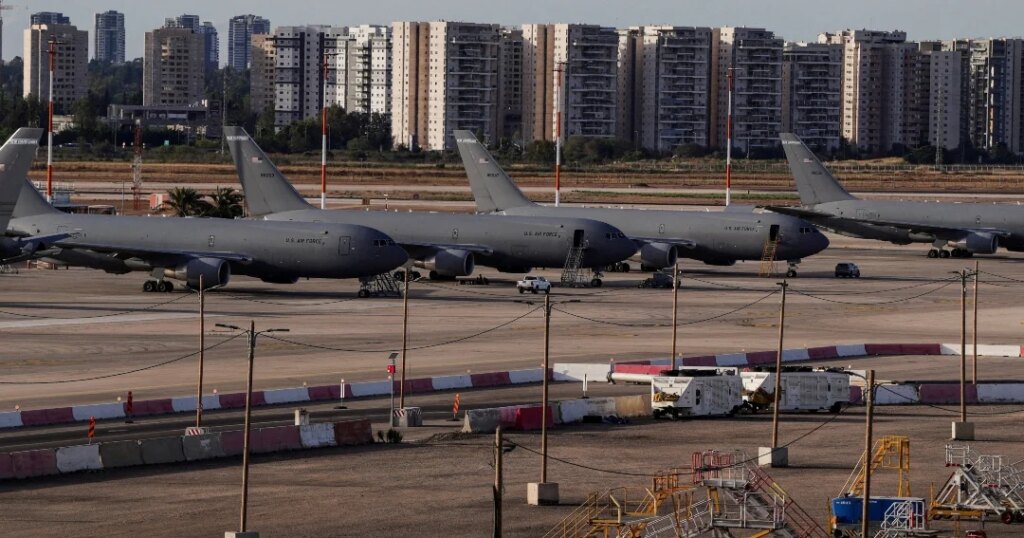
As reported by the New York Timesciting unnamed US officials, the United States was sending more fighter jets to the Middle East. These included F-16 and F-35 fighters, as well as additional tankers for in-flight refueling. These movements were signs of a possible escalation of American attacks.
U.S. Central Command described the recent U.S. strikes as a strategy to reduce Iran’s ability to threaten commercial shipping and quickly punish the Islamic Revolutionary Guard forces responsible for the attack that killed two U.S. service members on Friday.
That attack, which also left four soldiers wounded and one missing, brought to 16 the total number of American casualties since the US-Israel war against Iran began on February 28.
Brent crude rose to around $88 a barrel on Friday, its biggest weekly gain since April.
“The oil market is contracting again, which will likely keep oil prices higher,” he said by phone. Giovanni Staunovocommodities analyst at UBS Group.
“Repeated attacks on ships crossing the Strait of Hormuz have led to a decrease in the number of oil tankers leaving the Gulf” and “attacks on energy infrastructure are a factor that will likely keep market participants worried.” oil”.
In separate statements issued on Saturday, Saudi Arabia, the United Arab Emirates and Qatar expressed concern about the escalating conflict, and Jordan summoned an Iranian diplomat. The United Arab Emirates stated that attacking civilian infrastructure, such as schools, hospitals, desalination plants, energy facilities and transportation hubs, “cannot be accepted or justified under any circumstances.”
Tensions also increased in the Strait of Hormuz, a vital sea route for global energy supplies, which has been the center of the negotiations and where Tehran exercises its control. The Islamic Revolutionary Guard Corps Navy reported Sunday that it had intercepted four unidentified vessels attempting to use an unsafe route after ignoring warnings.
Two of the ships suffered accidents and were stopped short, while the others abandoned the route and returned, the navy reported. He assured that not a single drop of oil, gas or chemical fertilizer will cross the Strait of Hormuz without coordination and authorization.
Abandoned agreement
Tehran announced on Saturday that it would stop respecting the terms of the interim peace agreement after launching harsh attacks on Washington’s allies in the Middle East in retaliation for US attacks.
In addition to intensifying bombing attacks against Iran, the United States has once again blocked the country’s ports and revoked the exemption from sanctions on its oil exports.
The Iranian supreme leader, Mojtaba Khamenei, warned of “indelible lessons” for the United States. In a statement issued Saturday, he said American violations of the memorandum — a 60-day ceasefire while the United States and Iran negotiated terms for reopening the Strait of Hormuz and limiting Iran’s nuclear program — “have once again demonstrated to everyone the futility and invalidity of the American president’s signature.”
Khamenei He has not been seen in public since American strikes killed his father and seriously wounded him in the early days of the war. Iranian officials say 50 people have been killed and more than 500 wounded by US strikes since June 27.
Kuwait hits
Sunday’s attacks add to one of the worst sustained waves of Iranian bombings against Kuwait since the start of the conflict. Just this weekend, the Kuwait Oil Corporation reported that an unspecified oil facility suffered “significant material losses”, prompting its evacuation and several injuries, while two power plants and desalination plants have also been hit.
Kuwait Airways rescheduled most of its flights and the Ministry of Foreign Affairs warned that the repeated attacks on vital facilities “reveal an aggressive and systematic approach that attacks civilian objects, endangering the lives and safety of civilians,” in flagrant violation of international law.
Iran also attacked US radars and aircraft in Qatar, one of the main mediators between Washington and Tehran, according to the news agency. Tasnim. Central Command had previously reported that a series of US strikes on Friday hit surveillance sites, military logistics infrastructure, underground weapons depots and maritime infrastructure.
The escalation of hostilities has not reached the level seen at the height of the war in March and early April. Back then, the United States and Israel bombed Iranian cities on a large scale and Tehran launched thousands of drones and missiles against the Gulf Arab states and Israel.
He State Department The United States urged Americans to reconsider travel through or to the Middle East given the potential for “unforeseen escalation.”