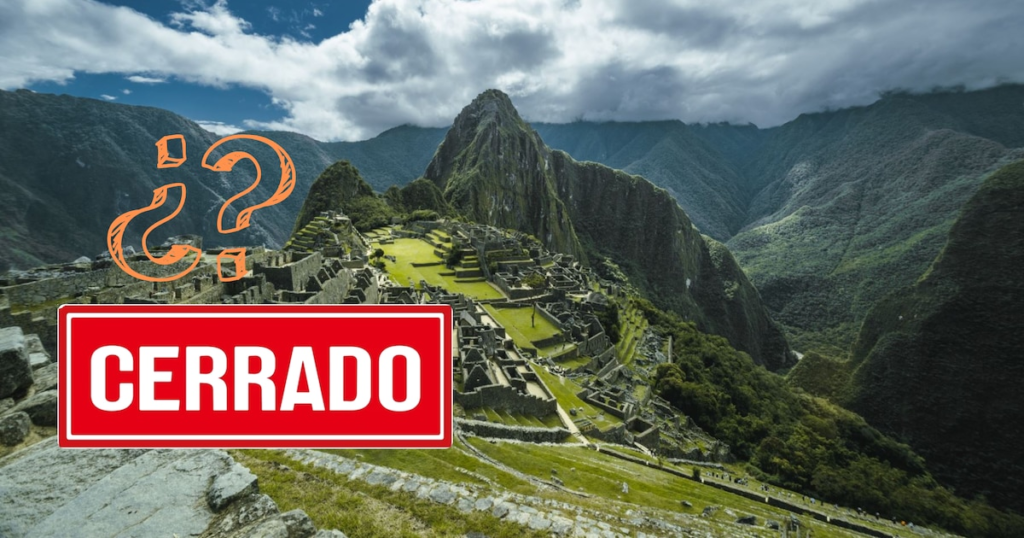
The recent announcement of provincial mayor of Urubamba, Ronald Vera Gallegosabout the possibility of closing Machu Picchu for one or two months from January 2026, triggered a strong reaction in different sectors of Peru. The proposal, disclosed in a period of uncertainty regarding access and management of the sanctuary, sharpened the discussion on the legality of the initiative and its economic impact in the country. Concern quickly reached the main actors in tourism, the local economy and the public administration, who fear consequences for all of Cusco and for the national economy.
The closure initiative, presented by the mayor in an interview, was perceived as direct threat to stability the main source of income in the region. The news generated alarm among the residents of the district, who consider the measure a risk to their well-being and to the thousands of families who depend on tourist activity.
The discussion about the authority to make a closure decision regarding a World Cultural Heritage site gained new relevance. The specialized voices highlighted the legal complexity that regulates Machu Picchu and the need for coordination between different levels of government.
The controversy brought to light the legal limitations of local authorities and the problems already existing in the management and planning of tourist services. In this context, the community and the economic sectors demand concrete responses and responsible actions to prevent a unilateral decision from endangering the future of one of the most emblematic destinations in the country.
The debate on the ability of the mayor of Urubamba to order the closure of Machu Picchu was addressed by legal specialists. André Sotaprofessor of Law at the Peruvian University of Applied Sciences (UPC), explained to Infobae Peru: “The power to close Machu Picchu as cultural heritage has a joint dynamic between the central government and the regional mayors. Under no circumstances can a district mayor make that decision alone (law 28296).” The expert specified that jurisdiction over the sanctuary corresponds to the central government, through the Ministry of Culture, with support from the provincial municipality.
In addition, he warned that the mayor’s proposal reveals ignorance about the norms and competencies of cultural heritage, in addition to legal risks for any authority that dictates a closure without technical justification. “The crime of usurpation of functions could be filed if the fraud of that ruler is demonstrated in the decisions that he has exposed to the media,” said Sota.
This position was supported by local and national authorities, who agreed that a decision of such magnitude cannot be adopted unilaterally by a municipality. The regulations require the coordinated intervention of various entities and restrict the scope of action of district mayors in decisions about the operation of Machu Picchu.
The closure of Machu Picchu, even for only one or two months, would have direct and profound consequences on the regional and national economy. Claudia Sícolidirector of the Economics and International Business Program at the UPC, explained to Infobae Peru that, according to information from the Ministry of Foreign Trade and Tourism (MINCETUR), “Cusco is the first exporter of tourist services nationwide, considering Machu Picchu as one of the main export centers in the sector, representing the 63% of total Peruvian exports of tourism services.
Between January and September 2025, Machu Picchu received 1,170,389 visitors, which represented an increase of 3% compared to the same period in 2024, although still without reaching the 1,210,804 of 2019. During that same period, other sites in Cusco also increased their influx: Saqsayhuaman, Ollantaytambo, Qenqo, Pukapukara and Tambomachay, according to the monthly tourism report for October 2025.
The doctor specified that 78.4% of the visitors are foreign tourists, with an average expenditure of between USD 1,000 and USD 1,500. Therefore, if the sanctuary were to close, the more than USD 150 million monthlywhich would cause a very strong blow to the Cusco economy. This impact would be evident in the drop in sales of fabrics and crafts, restaurants, hotels, transportation services and other sectors linked to tourism.
Furthermore, “the recovery of the sector after a stoppage of this type would not be immediate. International trips are usually planned at least six months in advance, which would affect visitors who have already scheduled their tours and those who are considering traveling to Peru in 2026,” Sícoli explained.
The closure would also harm domestic tourists, deepening the economic damage. Taking the experience of the pandemicrecalled that the flow of 2019 has not yet been recovered, so a new closure could extend its negative effects for years.
The residents warned that A total closure paralyzes hotels, restaurants and shopsand requested that the mayor measure his words given the global repercussions of his proposal.
Fernando Santoyo, president of the Cusco Chamber of Commerceemphasized that the proposal lacks legal basis. Santoyo affirmed that no municipal authority has jurisdiction over the closure of Machu Picchu and that the case showed failures in the management of processes such as the bidding for the Hiram Bingham highway. He stressed that the municipality had four months to complete the tender and, after almost ninety days, there is no relevant progress. He maintained that it was decided to move forward without adequate planning or participation of the private sector, which knows how the tourist circuit works.
The controversy highlighted the need for structural reforms in the management of the sanctuary to avoid recurrent crises. Claudia Sícoli indicated that Machu Picchu requires “the development and implementation of a unique and efficient system for the management of the marketing of admission tickets and of bus and train ticketsconsidering the maximum capacity allowed for each route.” This system must be used by tour operators under centralized supervision.
In addition, Sícoli highlighted the importance of the measures established in the Regional Strategic Tourism Plan (PERTUR Cusco 2019-2025), which include improving the management and operation of tourist services, attracting investments for sustainable tourism, facilitating accessibility and integration between destinations and diversifying the offer towards cultural, natural, adventure and experiential proposals.
Regarding the argument that the closure would serve to “organize tourism,” Sícoli specified: “To organize tourism it is not necessary to ‘close’ Machu Picchu; What is required is to strengthen coordination between the sectors involved, promote those successful initiatives of the past and provide benefits for locals and visitors, instead of imposing a measure that will only cause substantial economic losses and an irreversible devaluation of one of the emblematic destinations of Peru.”