The United Kingdom announced this morning that it has reached an agreement with the European Union on food trade, carbon dioxide emissions, immigration control and youth mobility, among other points.
These are advances that will be implemented in the coming years, still with details pending, but which represent the greatest rapprochement between London and Brussels since the terms of the divorce were agreed in December 2020. The rapprochement is the product of the Labor Government’s commitment from 2024, which has been more evident since last July.
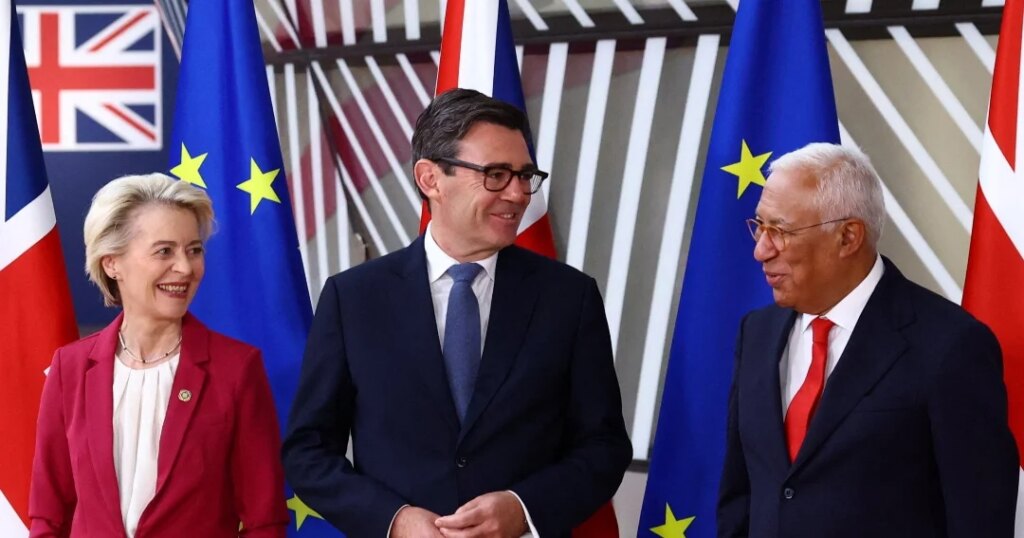
The British Prime Minister is expected to Andy Burnham (supporter of the country’s return to the EU), give more details this morning at a press conference in Brussels, together with the president of the European Commission, Ursula von der Leyen, and the Council of Europe, Antonio Costa.
Perhaps the most delicate point refers to YES, the English acronym for the European experience program. Finally, the United Kingdom agrees to open the door to 100,000 young people between 18 and 31 years old each year to study, work (including as an au-pair) and volunteer, although it remains to be clarified whether European university students will be able to pay the same tuition fees as the British, today, at a maximum of US$12,843 per course.
It is an aspect that will be left for later negotiations. In reciprocity, European countries will also have to let in, in total, a similar number of young British people. Everything should be ready by January 2030 at the latest.
Negotiations on sanitary and phytosanitary controls (SPS agreement) have also concluded, which will allow the vast majority of animals, animal products, plants and plant products between the United Kingdom and the EU to enter without the certificates and controls that are currently required. London believes this will save $6.69 billion. The agreement should apply from March 1, 2028.
Emissions, defense and energy…
The other major deal concerns emissions trading (ETS agreement), which creates the basis for mutual recognition between the EU and the United Kingdom and exempts the goods of both parties from the respective border carbon adjustment mechanisms. It will be implemented in 2028 and, according to the British version, it will have a positive impact of US$13.5 billion annually for the United Kingdom.
The agreement is broader and also contemplates advances in energy, immigration, information exchange, security and defense.
According to Downing Street accounts, the impact of Brexit has been estimated at approximately 4% of GDP, while the benefit derived from today’s agreements will be equivalent to 0.5% of GDP. GDP.
Burnham will now have to deal with the opposition that opposes the reestablishment of relations with the EU, although she has increasing support from the population, who assume that Brexit was a mistake and welcome greater rapprochement.
In this reset, in which London maintains its red lines (freedom of movement, customs union and single market), another underlying problem persists: London’s interest in advancing in the aspects that interest it most (trade, defense and immigration control), while Brussels calls for a broader agreement and has put on the table the so-called Farage clause, in relation to the leader of Reform UK who until not long ago led the polls and a great promoter of Brexit: guarantees that there will be no setback in the relationship in the face of a hypothetical turn of the country towards the populist right.