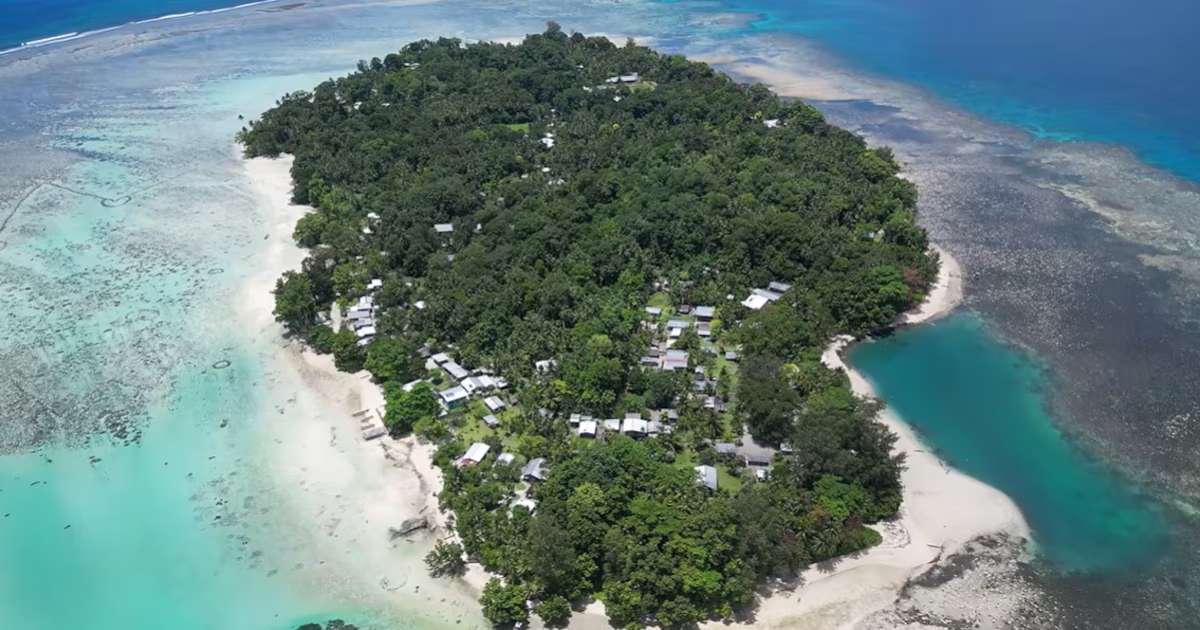
Only 7% of Ahus Island householdsa small atoll north of the archipelago of Papua New Guineahas enough drinking water to survive. The climate crisis hits that corner of the Pacific with extreme temperatures, a prolonged drought and acid rains that render catchment systems useless. A community that worked for decades to anticipate this scenario admits that nothing could have prepared it for what it faces today.
As reported Guardianthe teacher Josh Cinnerdirector of Thriving Oceans Research Hub of the University of Sydneyvisited the island in October with his team, which has been working with that community for 25 years. What they found was total paralysis: people lying on the floor of their homes, conserving energy and water. “The research team wondered if everyone had left the island, but then they looked inside the houses and saw them there, lying on the floor of their huts,” the scientist told the British newspaper.
Classes at school became half-day because The heat was unbearable for the children.. Fishing, a central activity of life in Ahus, fell sharply: without water and without strength, fishermen cannot go out to sea. The interconnected economy that sustained these islands for generations is disintegrating.
The country and much of Southeast Asia are going through a phenomenon of The Child of exceptional intensity that skyrocketed temperatures and drastically reduced rainfall. On the larger and more populated neighboring Manus Island, markets also ran out of food. Ahus fishermen also have few catches to exchange.
When it finally rained, the relief was short-lived. Forest fires in Borneo They covered the region with smoke and fog, and the precipitation came as acid rain. The inhabitants had to hastily disconnect their collection systems so as not to contaminate the few reserves they had left.
“What could prepare you for this? Even rain in a drought is toxic. The wells are dry. They have to row to Manus to try to get water, but they have no rights to it there. And the streams are drying up too,” Cinner warned the newspaper.
Michelle Suria resident of Ahus, described the situation Guardian: Almost all homes are hungry, people fish less and collect fewer resources from the sea due to the heat and the scarcity of drinking water. “Most people lie on the floor of their homes or on beaches to stay cool and conserve energy. Some stay in the sea for hours to cool off,” he said.
The most recent survey by the researcher’s team, carried out in October, confirms the dimension of the emergency: 81% of households declared they could not cope with climate change. The proportion of families with enough water to drink barely reaches 7%.
The paradox of Ahus is that it is not a community that ignored the signs. For years he received visits from United Nations Development Program (UNDP) and the National Climate Change Authority of Papua New Guinea, and collaborated with the World Wildlife Fund (WWF) and The Nature Conservancy to diversify your income. He built walls against the sea and installed water tanks.
“This is a place with a plan. But although they have been working for decades to be ready, nothing could have prepared them for what is happening now,” said the scientist.
The situation raises a fundamental injustice: the inhabitants of Ahus are among those who contributed the least to the emissions that cause global warming, but they are the first to suffer its most serious consequences. With 97% of the archipelago’s lands under customary regime, relocation options are almost non-existent.
“They have nowhere to go. They can’t do anything. There’s not much left to do. And it’s deeply unfair.”Cinner noted.
Meanwhile, in Antalya, Türkiyetens of thousands of scientists, activists and government leaders gathered for the 31st Conference of the Parties (COP31), the annual climate summit of the UNwhich concludes on November 20. The secretary general of the organization, Antonio Guterreswarned that “the brutal truth is that the climate crisis is surpassing us” and called for the end of fossil fuels.
From Australiathe researcher pointed out a contradiction in his country’s position, which corresponds to this edition of the COP: “We have policies against climate change, but we also subsidize the oil and gas industry at an astonishing rate and continue to open new fossil energy projects.”