More than 100 million Americans went to the polls for the midterm elections, which will define what remains of the presidency of donald trumpas well as the trade policies that have been affected by the imposition of tariffs from the North American country to several nations.
However, these elections will not only define Trump’s positions on tariffs, but will also draw the roadmap in Ukraine’s war against Russia, the regulation of artificial intelligence, tensions in Iran and the trade war against the Asian giant, China.
In these elections, to obtain the majority in the House of Representativesa party needs 218 seats. In it Senate51 seats are required to achieve an absolute majority.
However, if the upper house is divided equally (50-50), the vice president has the deciding vote, giving his party the control of it.
The forecast, according to different consultancies, placed the Democrats, the political party opposed to the president, with greater vote favorability. Donald Trump.
According to the survey of Reuters/Ipsos48% of registered voters went to the polls driven by an intention to reject trumpcompared to 25% in favor and another 25% who stated that his figure does not influence the decision, which makes these elections a direct plebiscite for his administration.
Among the independent electorate, this rejection of the president’s management reached up to 50%.
In economic matters, discontent is the main electoral driver, since 48% of Americans pointed to the high cost of living as the main factor in their voting intention, far above issues such as democratic norms with 26% or immigration, which reached 13%.
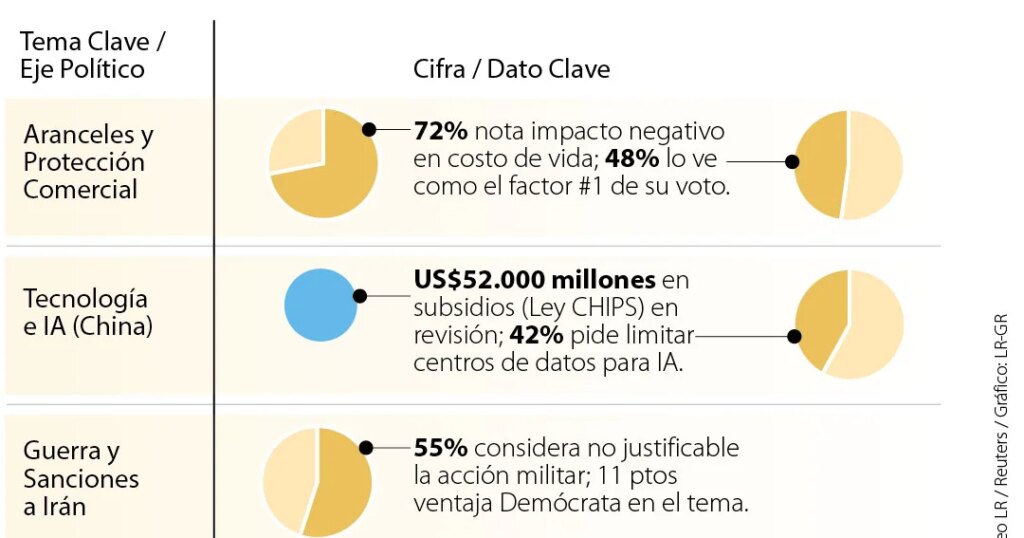
This concern is fueled by the imposition of tariffs, a trade measure that 72% of the electorate described as harmful to their economy.
Financial pressure is strongly reflected in the family environment, where 49% of voters and 54% of the Hispanic segment assured that their finances have worsened since January 2025. Added to this is the rise in fuel prices driven by the conflict in the Middle East.
The Republican victory would guarantee the continuity of the protectionist model with general tariffs of 10% and up to 60% for Chinese products, backed by tax cuts and productive deregulation to reduce inflation.
In contrast, the Democratic victory would seek to impose a legislative brake, exercise greater oversight over the Executive in the Congressseek non-tariff barriers and promote targeted subsidies to alleviate prices on essential goods.
On the international and technological front, the formation of the new Congress It will be decisive for three major disputes.
Regarding the trade rivalry with China and the advance of artificial intelligence, the debate is divided between the accelerated deregulation of the Republicans and the Democratic demand for ethical frameworks with strict export controls.
All this happens while the North American Legislature reviews US$52 billion in subsidies from the Chips Law and 42% of voters ask to limit the construction of large data centers due to their negative impacts on the environment.
On the other hand, the military intervention against Iran comes to the electoral process wrapped in broad social rejection, since 55% of voters believe that the action was not worth it compared to 25% who support it, giving the Democrats an advantage of 11 pps. in citizen preference on conflict management to impose greater supervision of war funds.
Finally, on the European stage, US$175 billion in military and economic aid to Ukraine is at stake. While the Republican ruling party pushes to cut this spending and negotiate energy trade exemptions with Moscow, the Democratic opposition advocates maintaining and increasing defensive support for kyiv.
Large donors to political campaigns have no limits on contributions
The influence of money in American federal politics is once again at the center of public debate given the role played by the sectors with the greatest purchasing power.
Under the current regulatory framework, large donors and investors lack effective limits when allocating million-dollar sums to super PACs (independent spending political action committees) and campaigns with the aim of shaping the electoral outcome and influencing the decisions of the US Congress.