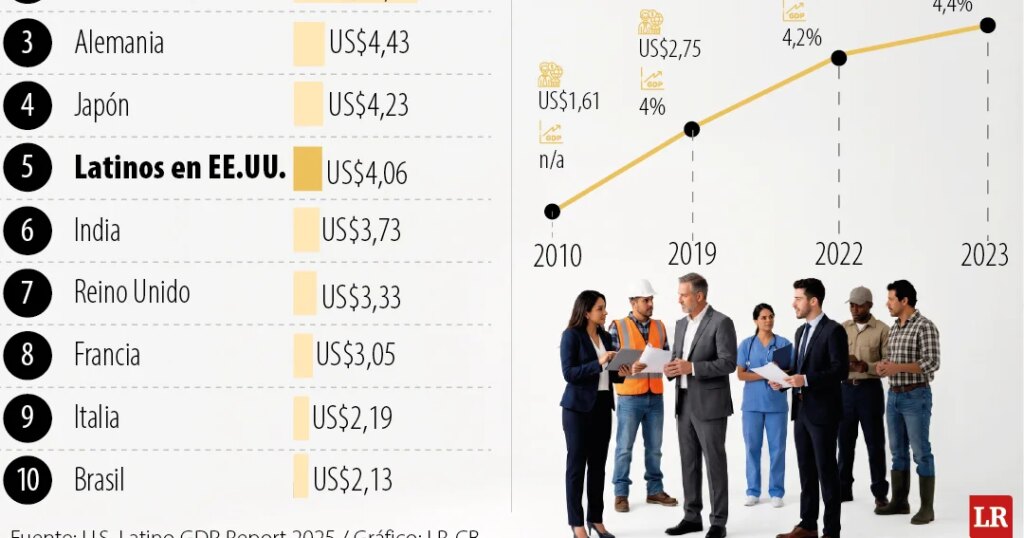
According to the latest US Latino GDP Report, US Latino GDP Report 2026, made by California Lutheran University, the gross domestic product, GDP, generated by latinos In the United States it reached a value of US$4.06 trillion in 2023, which leaves it as the fifth strongest economy in the world, if it were an independent country.
For analysts, the economic performance of Latinos in the United States is “extraordinary”, surpassing for the fourth consecutive year the GDP of countries such as India, the United Kingdom or France. Only the United States (US$27.81 trillion), China (US$17.79 trillion), Germany (US$4.43 trillion) and Japan (US$4.23 trillion) surpass it by the value of their GDP.
Latin GDP grows above that of the US.
Another of the relevant factors covered by the report is the growth of Latino GDP in the US. Among the 10 largest GDPs in the world, Latino GDP in the US was the third with the highest growth between 2010 and 2023, with an average annual growth of real GDP of 4.4%, growing even above the general US economy, 2.2%.
By 2023, real Latino GDP in the US grew 74.8%, going from US$1.61 trillion to US$4.06 trillion. This compared to GDP growth is not Latinwhich increased 27.4%. The Latino economy is growing 2.3 times faster than that of the United States in general, and 2.7 times faster than that of non-Latinos.
Latinos drive consumption
By 2023, Latin consumption reached a record of US$2.7 trillion, representing a consumer market even 20% larger than the entire economy of countries like Italy, with a GDP of US$2.26 trillion in 2023; or 24% larger than Brazil’s GDP, US$2.17 trillion in 2023.
At the national level, the consumption of the Latin bloc is 5% larger than the economy of states such as Texas (GDP of US$2.58 trillion in 2023) and 25% larger than that of New York (US$2.17 trillion in 2023).
Thus, the growth of real consumption by Latinos in the US grew 62.3% between 2010 and 2023, while that of non-Latinos increased 23.8%. In this sense, real consumption by Latinos grew 2.6 times faster than that of non-Latinos in the United States.
A trend that is explained by the increase in income. Between 2010 and 2023, the real salaries of Latinos in the US grew 61.5%, while those of non-Latinos grew by 21.4%, with a growth difference of 2.9 times faster than the Latino block.
Education-driven growth
Among the factors that explain the growth in value produced by the Latino community, analysts mention its rapid advancement in educational levels and its solid participation in the workforce.
Between 2010 and 2023, the number of people with a college degree grew 3.1 times faster for Latinos than for non-Latinos. By 2023, Latinos were 6.1% more likely to be actively working or looking for work than their non-Latino peers.
“The labor force participation advantage of Latinos is currently at its highest level. Together, these patterns underscore that Latinos are drivers of economic growth in the United States,” say the authors of the US Latino GDP Report 2026.