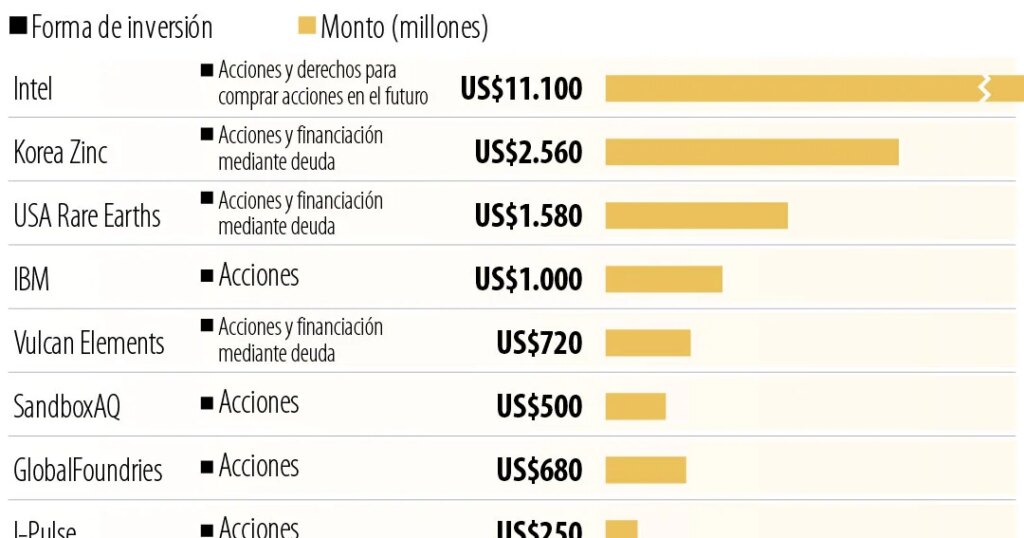
The Government of donald trump He wants to have more weight in the decisions of companies that he considers essential for the United States. Since his return to the White House, in January 2025, his Administration has announced more than 30 direct investments in companies, for US$27.6 billion, according to estimates by investment bank Jefferies.
The bet covers chip manufacturers, mineral producers, energy companies and defense groups. The objective is to secure the materials and technology that the country needs, in the midst of competition with China.
To do so, Washington is entering as a shareholder in companies in strategic sectors.
This means that the Government You can become a part owner of those companies. Depending on the participation and conditions of each operation, this position may give you the ability to influence important decisions.
Among the companies mentioned in the report are Intel, Korea Zinc, USA Rare Earths, Lithium Americas, IBM and L3 Harris.
Semiconductors concentrate the majority of the bet, with 46% of the total amount. They are the small components that allow computers, phones and other electronic equipment to function. They are also essential to develop artificial intelligence, one of the areas in which the United States seeks to maintain its leadership.
The second front is critical minerals, which account for 36% of the investment. Materials such as lithium, used in batteries, and tungsten, used in industrial and defense equipment, appear there. Washington’s concern is to have a secure supply to manufacture products that depend on these resources.
82% of the resources are concentrated between chips and minerals. The rest is distributed between quantum computing, with 8%; energy, with 6%, and defense, with 4%. Quantum computing seeks to develop equipment capable of solving certain problems that would be very difficult for current computers.
Although the strategy has been compared to that of Sepi, the Spanish entity that manages public stakes in companies, the United States still does not have a single organization that brings together these investments. The operations are distributed among different entities of the Government.
He Department of Commerceled by Howard Lutnick, has led more than 20 of the operations, according to the report. One of the tools used is the Chips Law of 2022, approved during the presidency of Joe Biden to support semiconductor production. Some transactions convert previously granted public financial support into company shares. Intervention can also take other forms.
In US Steelthe Government obtained a “golden share” in 2025 as a condition for approving its purchase by the Japanese Nippon Steel. This mechanism allows him to veto certain strategic decisions of the steel company.
The shift expands a policy that was already gaining strength. During his first term, trump used tariffs to protect American industries.
Biden maintained support for sectors considered essential through subsidies and guarantees. Now, the purchase of stakes adds a more direct way to intervene in companies.
The White House also opened discussion on the creation of a sovereign wealth fund, a state vehicle to manage investments. In February 2025, trump ordered to Trade and to Treasure study that possibility.
For companies, this strategy opens the door to public resources and, for Washington, to gain influence over chip and mineral production.
The Spanish State also moves its chips
Spain has also reinforced its presence in companies that it considers strategiccombining the purchase of shares with controls on foreign investment. He Government of Pedro Sanchez took 10% of Telefónica to respond to the entry of the Saudi group STCacquired a stake in Talgo and increased its presence in Indra. At the same time, it has used a mechanism known as an “anti-takeover shield,” which allows it to block or place conditions on purchases of companies in sensitive sectors.