Coffee is a fundamental element in the morning routine of many people around the world, and it is also one of the most traded agricultural products globally.
The production of this fruit, native to the Ethiopian highlands, is concentrated in a relatively small number of countries, most of which are located within the “coffee belt” between the tropics of Cancer and Capricorn.
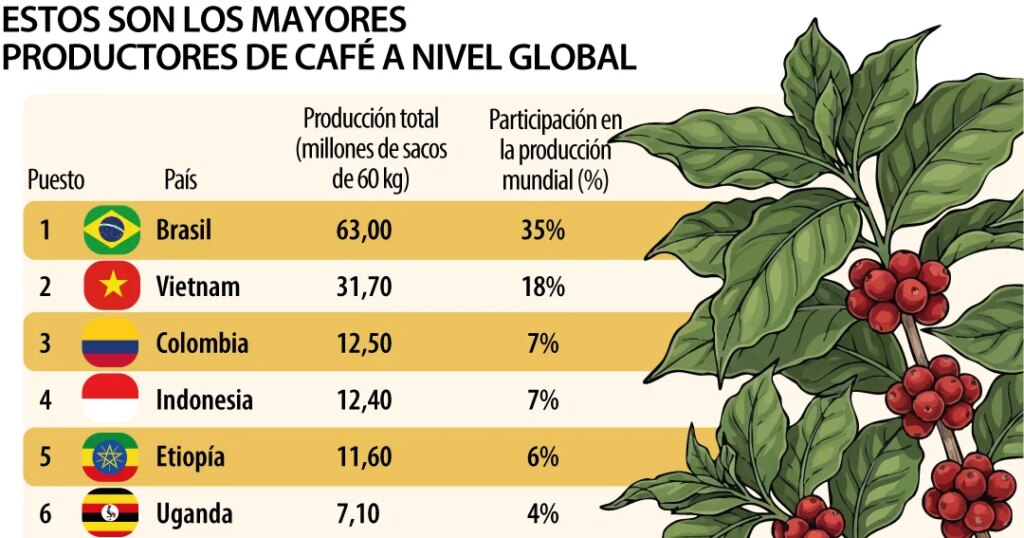
Although this product is one of Colombia’s flagships, the country is not the largest producer worldwide, but it does sit on the podium, since, according to figures from the Foreign Agricultural Service of the United States Department of AgricultureIn the 2025/2026 commercial period, Brazil is the largest producer of green coffee in the world, expressed in 60-kilogram bags of unroasted coffee beans.
According to the data, Brazil produced 63 million 60-kilogram bags of green coffee beans, which is equivalent to 35% of world production, producing more than the second, third and fourth places on the list combined. Most Brazilian production is of the Arabica variety of coffee, a type of fruit typically grown at high altitudes and widely used in the specialty and high-end coffee markets.
Behind the Brazilian giant, in second position, is Vietnam, which in the last commercial period reached 31.7 million 60 kg bags, of which 30.5 million belong to the Robusta variety and 1.2 million to Arabica, which places the Asian country as the absolute global leader in production of Robusta coffee, also registering the highest average yield per hectare among the producing nations in the world, reaching 2.9 metric tons per hectare in a harvested area of approximately 620,000 to 644,000 hectares in its Central Highlands, according to figures from the MMinistry of Agriculture and Rural Development of Vietnam.
The coffee podium is completed by Colombia, which registered an adjusted production volume between 12.5 and 13.8 million bags, this after a historic 2024/2025, where the country reached 14.86 million 60 kg bags, the highest figure recorded in 33 years.
For Colombia, this fruit is the main non-mining-energy export product, supporting 550,000 coffee-growing families in 837,000 cultivated hectares, according to figures from the FNational Federation of Coffee Growers.
The top five is completed by Indonesia and Ethiopia, with a consolidated production of 12.4 and 11.6 million 60-kilo bags, respectively, and each representing about 7% of the global coffee market.