Today the National Administrative Department of Statistics, Danewill publish May inflation data in Colombia, a key figure to understand if the economy continues to accelerate in terms of prices or if it begins to show signs of stabilization. The context arrives marked by a piece of information that has already set off alerts. Colombia was ranked as the second country with the highest inflation within the OECD in the most recent report, only behind Turkey.
In April, annual inflation in Colombia was 5.68%, which implied an increase of 0.52 percentage points compared to March (5.16%) and consolidated a rebound trend that has surprised the market in recent months. This behavior contrasts with the previous expectation of a more sustained moderation in prices, which has not materialized with the expected strength.
From a technical point of view, the increase would be explained by shocks in energy and fuels. Analysts point to the increase in gas and electricity prices, the adjustment in gasoline, the deficit of the Fuel Price Stabilization Fund, Fepcand possible climatic effects associated with the El Niño phenomenon as the main factors behind inflationary pressure.
At the international level, the most recent report of the Organization for Economic Cooperation and Development, OECDplaces Colombia in a particularly striking position within the bloc. The country is currently the second with the highest inflation among the 38 members analyzed, only surpassed by Türkiye.
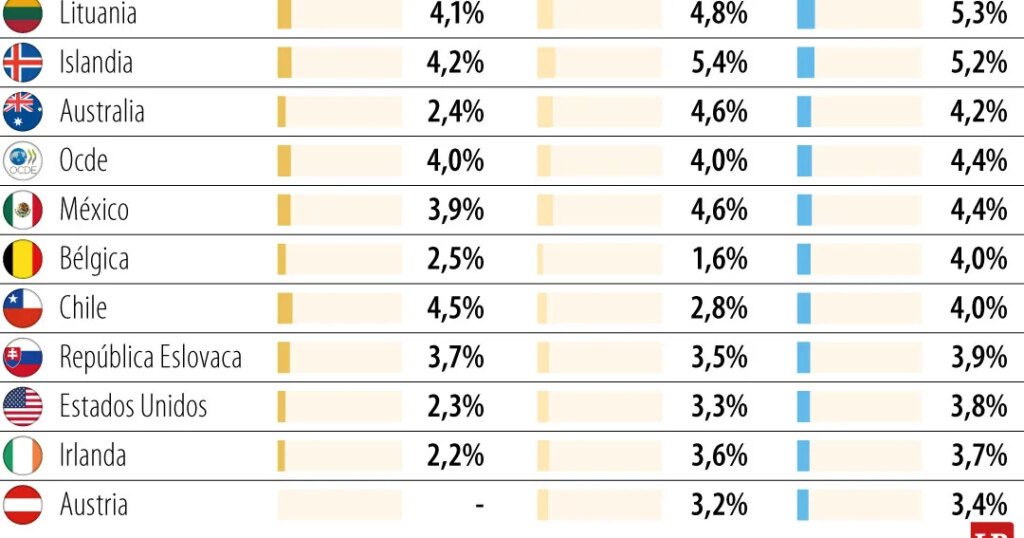
According to the report, year-on-year inflation in OECD increased to 4.4% in April 2026, compared to 4.0% in March. This increase was mainly driven by the rise in energy prices, which shot up 13.2% year-on-year, while food also showed an increase of up to 4.0%. The inflation Core, meanwhile, remained relatively stable at 3.6%, suggesting that much of the pressure comes from global energy factors.
The report details that inflation increased in 23 member countries, with especially strong jumps in Belgium, Chile, Greece, Italy and Turkey. In contrast, few economies managed to completely contain the rise in prices, reflecting an environment still vulnerable to external shocks.
Higher inflation in the block
The case of Türkiye continues to be the most extreme, with inflation of 32.4%, well above the rest of the OECD. However, second place is occupied by Colombia, with a variation of 5.7%, which positions it immediately after the Eurasian country and above developed and emerging economies in the bloc.
This result is particularly relevant because Colombia exceeds both the OECD average (4.4%) and the G7 average (3.2%), evidencing a gap compared to the world’s main economies. Meanwhile, countries such as the United States (3.8%), Spain (3.2%), Germany (2.9%) and France (2.2%) show more moderate levels, and economies such as Switzerland (0.6%) or Denmark (1.4%) maintain very low inflation.
How did the region fare?
In Latin America, behavior is heterogeneous. Mexico registered 4.4%, Chile 4.0% and Costa Rica even negative figures (-1.6%), which shows that the inflationary phenomenon has very different dynamics, although Colombia stands out for its relative position within the global ranking.
Expectations point to new acceleration
Market expectations for May data reinforce this reading of persistent pressure. Analysts predict a new increase in the Consumer Price Index, CPI, with a consensus close to 5.90%. However, the range of projections is wide: while Positive and Bancolombia They estimate figures above 6% (6.06% and 6.02% respectively), Itau projects 5.77%, the lowest estimate in the market. In any case, the consensus suggests an acceleration compared to April, amid pressure on gas, electricity and gasoline prices.