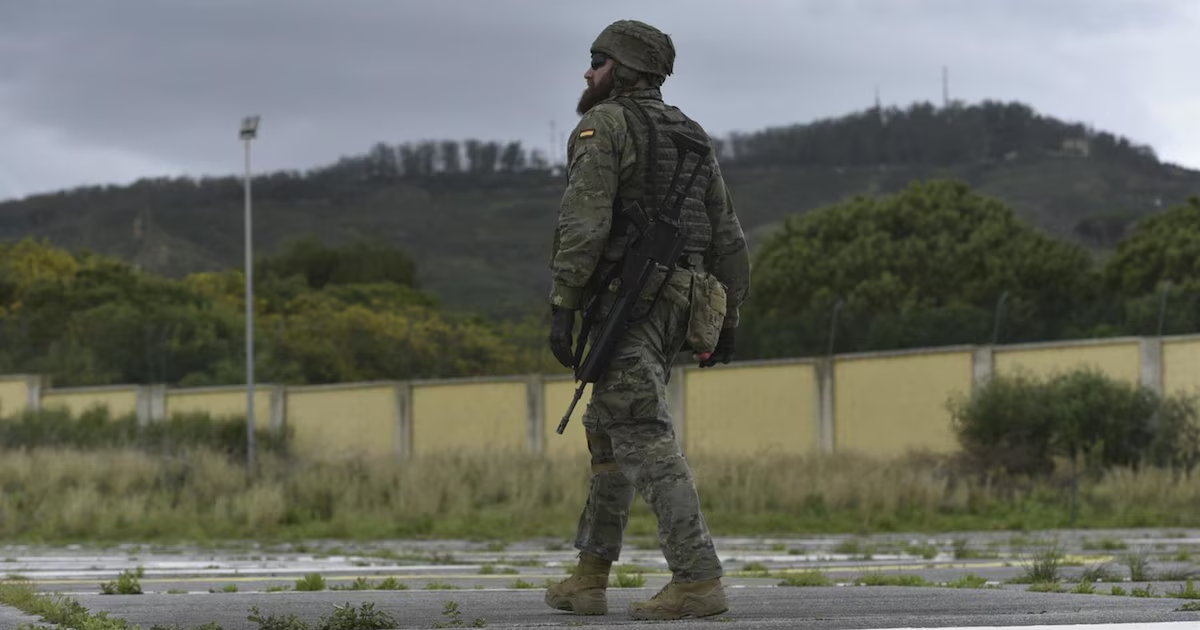
The Supreme Court has sentenced an Army soldier to two sentences of ten months in prison after being absent from his authorized residence and his military assignment for more than a year, residing in Morocco without authorization or control by his superiors. The Military Chamber of the High Court has rejected his appeal, also imposing military suspension from employment and special disqualification for public office and passive suffrage.
The soldier was authorized to residence in Melilla after requesting a medical leave for a traffic accident. However, starting in July of that same year, he stopped attending medical checkups and did not meet the requirements of his unit. The unit attempted to locate him by telephone and by burofax, but were unable to contact him at his accommodation.
Days later, the missing soldier sent medical reports from Morocco, in French, through WhatsApp, which indicated an accident in that country, but did not provide any other document proving that he could leave the national territory or to breach the obligations of communication with the unit and presence. The soldier also did not return to work after completing another leave for personal reasons requested in November 2023, remaining in irregular situation outside military control until December 2024, when he belatedly regularized his situation.
Finally, it was learned that he remained in Nador, Morocco, outside of any military control and without communicating his address. Furthermore, the sentence mentions that during that period he made various entries and exits from the Nador International Airport and even traveled to Germany, which showed that There was no physical or medical limitation that prevented him from moving or fulfill their military obligations. During this time, attempts to subpoena and locate were unsuccessful, resulting in led to his arrest and subsequent presentation to the unit. The defense presented a psychiatric report, prepared at the Gómez Ulla Central Defense Hospital, which described an anxious adaptive disorder, without it being proven that this condition nullified his criminal responsibility.
In the judicial process, the original sentence of the Second Territorial Military Court of Seville imposed the sentence in December 2025. The defense appealed to the Supreme Court alleging errors in valuation of evidence, improper application of the Military Penal Code and lack of consideration of personal circumstances. The Supreme Court has examined the reasons and concludes that neither the medical reports nor the defense allegations justified the prolonged absence, nor did they exempt them from military obligations. With this resolution of May 13, 2026, the ruling is confirmed and the costs of the appeal are declared ex officio.