Morgan Stanley He once again put on the table a scenario that always generates concern in Colombia: a dollar above $4,000. In a report on Latin American currencies, the US bank warned that the Colombian peso will continue to be under pressure in the coming months due to political uncertainty, fiscal doubts and an international context that still remains complex.
Although the entity projects a dollar close to $3,825 for 2026 and $3,925 for 2027, it also recognizes that the risks continue to lean towards greater depreciation of the Colombian peso. In a more adverse scenario, the bank considers that the currency could once again exceed the $4,000 threshold.
The warning comes at a time when the market has already begun to anticipate the 2026 presidential elections and the possible impact these could have on local assets, including the exchange rate.
Morgan Stanley pointed out that electoral uncertainty will be one of the factors that could most influence the behavior of the exchange rate in Colombia during the next year. The bank too mentioned concerns related to the country’s fiscal situation and the Government’s ability to maintain the stability of public accounts.
Added to this is the conflict in the Middle East, which has kept oil prices high and contributed to inflationary pressures globally. According to the bank, markets could still be underestimating how persistent inflation will be in Latin America. In the Colombian case, this combination of factors ends up having a direct impact on the peso.
The entity was even clear in stating that, from current levels, exchange risks continue to point more towards a depreciation of the currency than towards a solid recovery of the Colombian peso.
The rise of the dollar would have direct effects on the economy. Imports become more expensive, some costs for companies increase, and goods such as technology, vehicles, or international travel services tend to be impacted quickly.
Additionally, a higher dollar can put more pressure on inflation, at a time when the Bank of the Republic remains attentive to price behavior and interest rate decisions.
Still, some sectors could benefit. Exporting companies or those that receive income in dollars tend to strengthen when the exchange rate rises, since their income in foreign currency increases in local terms.
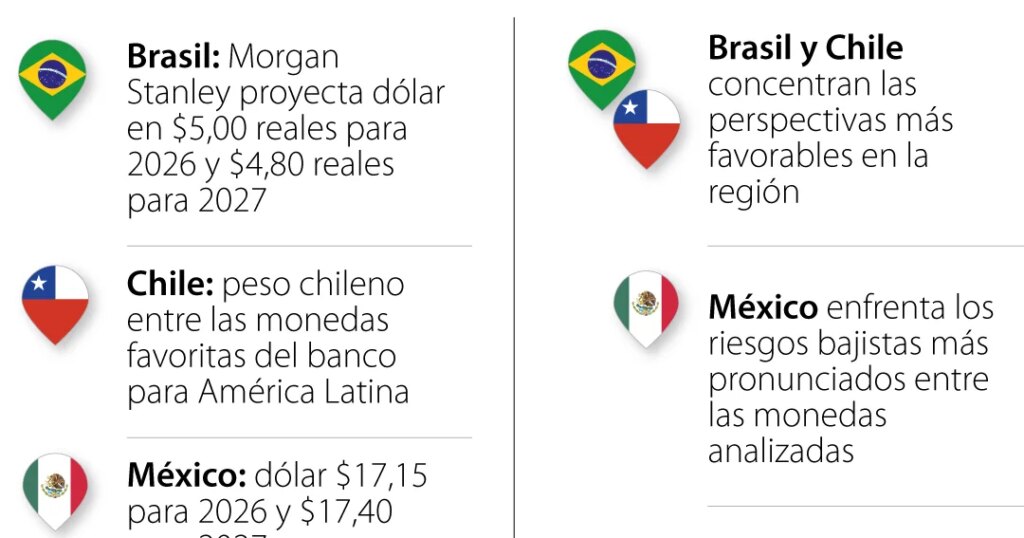
The report also shows relevant differences between the countries of the region. Morgan Stanley maintains a more positive view of Brazil and Chile, currencies that it considers better positioned compared to the rest of Latin America.
In the case of Brazil, the bank even contemplates the possibility of an additional recovery of the real if the market perceives signs of greater fiscal discipline after the elections.
On the other hand, Colombia, Peru and Mexico appear as markets most exposed to episodes of volatility, especially due to political and fiscal factors.
For now, the behavior of the dollar will depend on several fronts simultaneously: the monetary policy decisions of the central banks, the evolution of the international price of oil and the political environment that begins to consolidate in Colombia in view of the elections.
Local weight among the strongest emerging companies
Despite the volatility experienced in recent days, marked by tension in the Middle East and local political uncertainty, the Colombian peso has demonstrated resilience. So far this year, the national currency has maintained its strength against the dollar and was ranked as the seventh most revalued emerging currency from January 2 to yesterday, with a cumulative gain of 2.89%. With this result, the Colombian peso managed to surpass currencies that have been devalued such as the Turkish lira (-6.26%) and the Indian rupee (-5.74%).