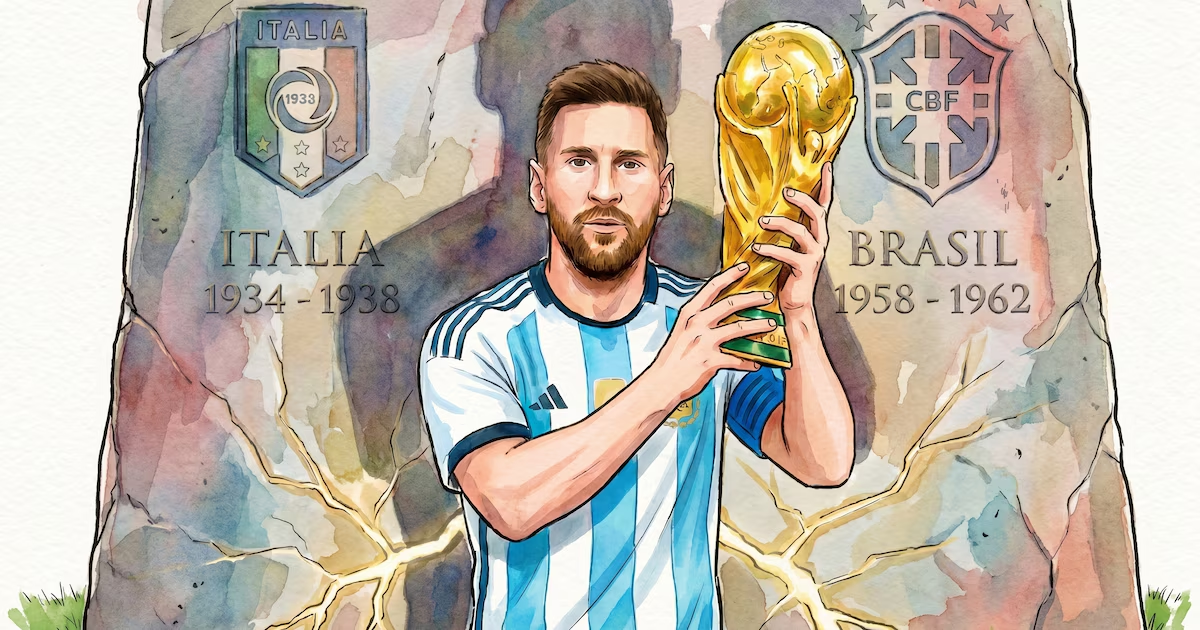
Get the World It is an achievement that only eight countries have achieved since the first edition in 1930. Becoming part of the ecumenical event is an achievement that every football lover longs for. Raise the trophy that establishes a team as the best on the planet gave hero status to almost all the players who have achieved it. That is why conquering the glory of the most important competition on two consecutive occasions is an epic rarely seen. The argentine national team has the opportunity to break a 64-year “curse.”
History indicates that Italy and Brazil are the only teams that were able to win twice in a row. The Azurra celebrated in the World Cups of 1934 and 1938 and in doing so wrote one of the most unique chapters in international football.
The first of those titles came in the summer of 1934, when Italy received the second edition of the World Cup between the roar of the stands and the long shadow of power. The dictator Benito Mussolini had turned the tournament into a showcase of the fascist regime and the pressure on the Azzurra It was as visible as the official posters that wallpapered the host cities. The selected one, directed by Vittorio Pozzodid not give in to that weight and advanced game by game in a direct elimination format – a novelty for that edition – that did not allow for setbacks.
The road was not clean. The series before Spain It was marked by physical harshness and by referee decisions that generated controversy throughout Europe. A playoff match was necessary for Italy to advance, and that tension did not leave the team until the final against Czechoslovakia, played in Rome before more than 50,000 spectators. The Czech team took the lead on the scoreboard, but the Italians equalized and forced extra time – the first in the history of a World Cup final. Angelo Schiavio scored the goal that closed the 2-1 and gave the azurri the crown.
Four years later, the setting changed but the protagonist was the same. France hosted the third edition of the tournament in 1938, with 15 selections, 18 matches and 84 goals over just two weeks, between June 4 and 19. Italy arrived as current champions and with the mission of becoming the first team to defend the title outside of its own territory.
The man who carried the armor of that team was Giuseppe Meazzacaptain and figure of the Azzurra. Pozzo, his coach, described him with a phrase that remained engraved in football memory: “His presence was similar to starting every game up 1-0.”
Argentinafor his part, was absent in 1938 for different reasons. The country had aspired to organize the tournament and, upon losing the venue to France, opted not to compete. He then tried to request his exclusion from the playoffs, but the FIFA rejected the request.
As Italy progressed, the tournament had its own goal poet. Leonidas da Silvafront of Brazilscored in all four games he played and finished the tournament with 7 pointsthe highest record in the competition. His absence in the semifinal against the Italians was one of the most talked about mysteries of that World Cup: the coach Ademar Pepper decided not to align him with the argument of preserving him for a final that Brazil would never reach. “I let him rest,” was the phrase that earned him popular rejection and, for a time, the impossibility of returning to Rio de Janeiro without facing the fury of the fans.
The final of France 1938 was played at the Yves-du-Manoir stadium. Opposite, Hungary. Italy did not need extra time this time: Gino Colaussi scored two goals, Silvio Piola another two, and the final 4-2 left no room for doubt. The Hungarians scored through Pál Titkos and György Sárosi, but it was not enough. Thus, the Azzurra She became the first two-time champion.
24 years later, a team lifted the trophy on two consecutive occasions: Brazil in 1958 and 1962. The Canarinha arrived at the Swedish edition with a figure who was about to write history: Pelé. The young man of 17 springs debuted in Gothenburg on June 15 and arrived never to leave again.
With Didí, Garrincha and Zagallo in the attack, Brazil advanced without obstacles. In the semi-finals, Pelé scored three goals against France in a 5-2 victory. On June 29, in the final, the Swedes fell 5-2 to a football that did not recognize borders or schemes. Vavá scored twice; O’Reytwo others. He Scratch raised the trophy Jules Rimetwhich was the one that was delivered at that time, for the first time in its history. Argentina’s participation in the 1958 event was known as “Sweden’s disaster”, but that is another story.
Meanwhile, Garrincha came to Chile 1962 as a secondary figure. Pele was the axis of the system, the backbone of a team that the coach Aymoré Moreira had built around its star. But the tear that the star suffered before Czechoslovakia In the group stage it changed the geometry of the tournament forever.
Manuel Francisco dos Santosnicknamed Garrinchahad a deviated spine and twisted legs. The Brazilian biographer Ruy Castro, in his book Lonely Starwrote that the footballer “defied the laws of anatomy”. That physical condition, far from being a limitation, was his most lethal weapon: a body that the defenders could not calculate because human mechanics did not contemplate it.
The breaking point came before Spain. With the score against and the classification at risk, Garrincha unlocked the scheme that Helenio Herrera had designed to contain it. In the quarterfinals, against England in Vina del Marscored two goals and assisted on the third.
In the semifinals, against the local Chili in it Santiago National Stadiumscored two more goals in a 4-2 victory. He ended up being sent off for responding to systematic fouls by local defenders. The FIFAin an unprecedented decision for the time, accepted the efforts of the Brazilian confederation and qualified him for the final. The previous warning and red card were reconsidered by the organizing committee.
Brazil defeated Czechoslovakia 3-1 in the final with goals from Yellowish, Zito and Vava. Garrincha He played that game with a high fever, but his mere presence on the field altered the tactical approach of the Czech technical director. Rudolf Vytlačil. He finished as the tournament’s top scorer with four goalsa distinction he shared with five other footballers, although the award for best player of the competition was exclusively his. That was the last time a team was crowned twice in a row.
15 editions of the World Cup have passed since then and no team has achieved the milestone again. Argentina, after consecration in 1986, was close to achieving it in 1990, but lost in the decisive duel against Germany. Brazil, in 1998, lost in the final with France and was unable to retain the 1994 title. In 2022, the Albiceleste deprived the French team of joining the select group of two-time champions.
The 2026 edition will be the perfect opportunity for Argentina to break that “curse.” First, you will have to get through the group stage. Their path in defending the title will begin on Tuesday, June 16 against Algeria, at Kansas City Stadium. Then, on Monday the 22nd, they will face Austria. On the last date, 06/27, it will close with Jordan.