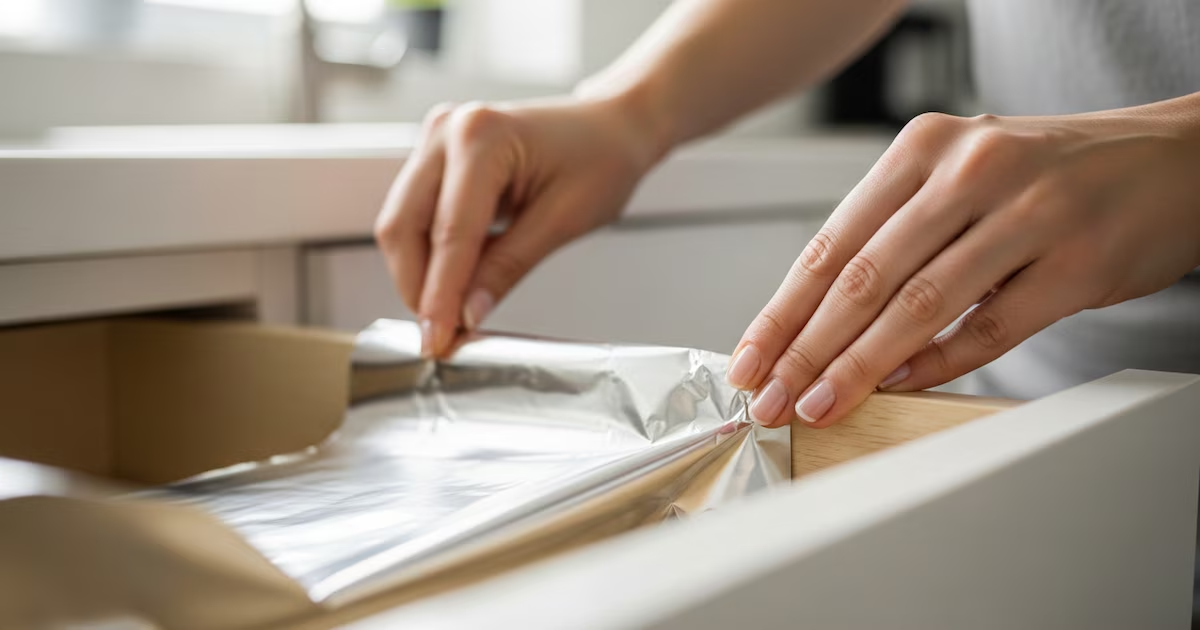
A kitchen trick that is circulating strongly on social networks has technical support: line home drawers with aluminum foil Protects clothing, utensils and stored items from moisture, mold and indoor odors. The practice, which many apply intuitively, finds its foundation in the physical properties of aluminum, documented by the European Aluminum Foil Association (EAFA, for its acronym in English).
The material is not new in homes. The EAFA records that household aluminum foil was introduced to the American market in the late 1920s and that, by the mid-1930s, it was already marketed in Europe under the attributes of “sterile, bacteria-free, clean and reusable.” What has changed over time is the understanding of its uses beyond the kitchen.
The main reason aluminum foil works as a drawer liner is its Total barrier against light, gases and humidity. According to the EAFA technical document, this is “the main reason for its wide use in food and beverage applications”, given that even in very reduced thicknesses “it offers perfect protection and preservation of the aroma and characteristics of the product”.
Transferred to the domestic environment, this same barrier acts as a physical shield between the wood of the drawer—which absorbs and releases moisture naturally depending on environmental conditions—and the stored objects. Damp wood is a favorable substrate for the proliferation of fungi. The United States Environmental Protection Agency (EPA) warns that mold can begin to grow on damp surfaces within 24 to 48 hours, and its spores, invisible to the naked eye, float in the indoor air of homes.
Hygiene is another important technical argument. The EAFA document specifies that “aluminum foil is completely sterile thanks to the high temperature annealing process” and that “does not harbor or promote the growth of bacteria.” This property, which originally justifies its use in contact with food, also explains why it acts as a neutral surface inside a drawer: it does not generate or accumulate the microorganisms that produce the characteristic musty smell.
Added to this is the aroma protection. The EAFA points out that aluminum “can help extend the useful life of sensitive products and prevent their deterioration”, which in domestic practice means that stored clothing or textiles do not absorb the smell of old wood or confinement.
Installation requires no adhesives or tools. The key lies in a specific mechanical property of the material: its “dead fold effect”described by EAFA as the ability of aluminum to “memorize its shape, particularly where folds occur.” By pressing the sheet against the bottom and corners of the drawer with your hands, the material adopts and retains the shape of the space without the need for glue.
The process consists of cutting a sheet the size of the bottom of the drawer, placing it shiny side up and shaping the edges with your fingers. The matte and glossy sides have the same barrier performance: the difference between the two sides is a consequence of the manufacturing process, not a functional distinction. The EAFA explains that, to obtain the thinnest sheets, two layers are laminated simultaneouslywhich causes the inside of the process to remain matte and the outside to remain polished. By separating the two layers, each sheet has one side of each type.
Placing the shiny side up has an additional practical advantage: it reflects the little light that enters the drawer when it is opened, making it easier to see the contents. The sheet can be changed every few months or when it shows signs of deterioration.
The aluminum foil acts as a passive method: it stops the transfer of moisture from the wood, but does not modify the air conditions inside the box. The EPA states that active control of ambient humidity is the bottom line strategy for preventing mold indoors. For small spaces such as drawers, domestic science and official guidelines point to several complementary alternatives.
The silica gel bags They are the most recommended active absorption method. The gel captures water molecules trapped in the air in the drawer before they condense on the clothes or the walls of the furniture. Its use is regulated by the United States Food and Drug Administration (FDA) for environments in contact with food and medicines, which accounts for its safety.
The common school chalkcomposed of calcium carbonate, performs a similar function on a smaller scale. Being a porous mineral, a small bunch placed at the bottom of the drawer absorbs excess steam before it condenses. It is an economical and easily accessible alternative.
The EPA recommends keeping the indoor humidity between 30% and 50% —with a maximum ceiling of 60%— to stop the appearance of fungi. The agency indicates that this parameter can be measured with a hygrometer available in hardware stores for between $10 and $50. When humidity exceeds this threshold, the use of air conditioners or dehumidifiers is the most effective measure.
Periodic ventilation is the simplest resource. The EPA emphasizes that no physical barrier is definitive if the air is stagnant, and recommends “increasing ventilation by opening doors and windows.” In the case of drawers, the equivalent guideline is to open them completely during dry days to force air renewal and prevent the accumulation of the smell of confinement.