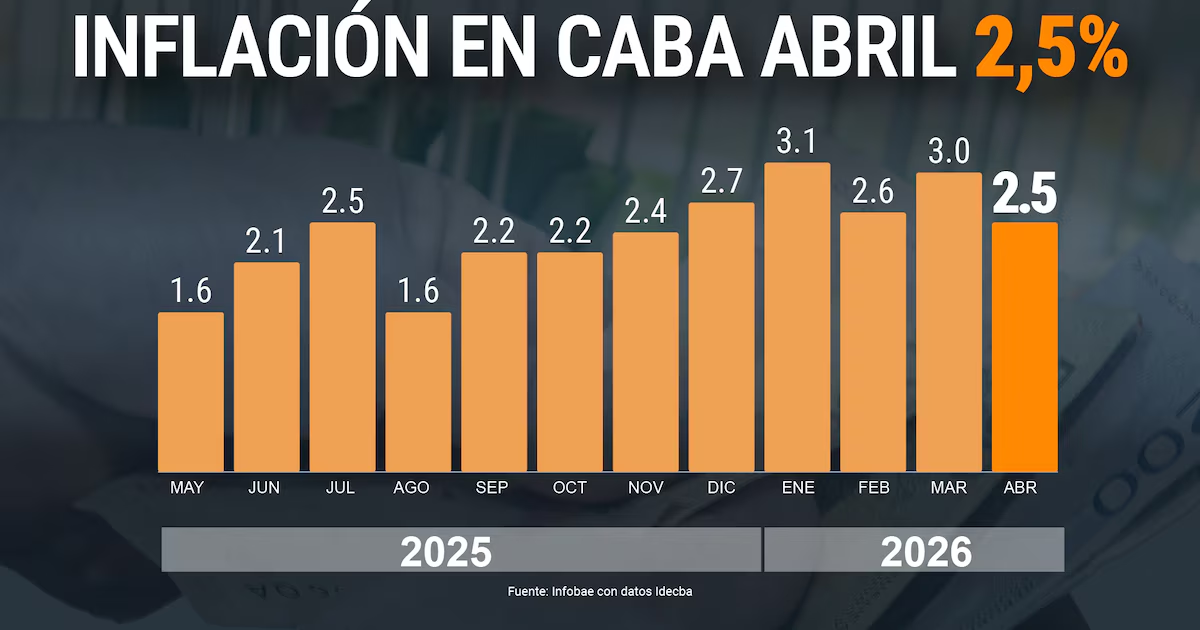
The inflation in the City of Buenos Aires registered in April an increase of 2.5% and thus marked a slowdown compared to March, when the price increase had been 3%, according to the Buenos Aires Institute of Statistics and Censuses. With this result, the IPCBA index accumulated an increase of 11.6% in the first four months of 2026 and a interannual variation of 32.4 percent.
The Indec will release national inflation this Thursday and there is great expectation on the part of the Government and analysts to confirm that the pace of price increases has slowed in April, after a third month of the year in which inflation climbed to 3.4%. For now, the consulting firms surveyed by the Central Bank in the Survey of Market Expectations (REM) they anticipated that April inflation will be 2.6% monthly. If the projection is met, it would imply the first slowdown in the CPI in almost a year. In any case, the figure is still far from the value of less than 2% that the president expected. Javier Milei for this year.
The CABA report reflected that the Transportation division showed the greatest impact on the general indicator, registering a monthly increase of 5.4%. The survey attributed this variation to updates in the prices of fuels and lubricants for vehicles for household use and, to a lesser extent, to increases in air tickets and urban bus fares.
Within Transportation, the operation of personal transportation equipment increased 8.3% monthly and accumulated an interannual variation of 55.5%. Passenger transport services grew 4.8% in April, while air transport registered an increase of 14.5% monthly.
The second division with the highest incidence corresponded to Housing, water, electricity, gas and other fuelswhich advanced 2.2% during April. The report indicated that the variation responded to increases in rent, expenses and water supply. In the opposite direction, residential natural gas rates per network showed a drop that reduced pressure on the index.
Rents increased 2.7% monthly and accumulated an interannual variation of 34.8%. Common household expenses increased 2.8% in April and the water supply registered an increase of 4%. Meanwhile, the gas service showed a monthly drop of 2.4%.
The division Food and non-alcoholic beverages recorded an increase of 1.4%. The main boost came from increases in milk, dairy products and eggs, which rose 2.5%, and in bread and cereals, with a variation of 2%. Fruits showed a drop of 4.3%, which moderated the general result of the division.
Among the products surveyed by the Buenos Aires organization, a kilo of French bread reached an average price of $4,225.23, while whole milk was at $1,737.33 per liter and a dozen eggs at $4,060.13. The kilo of roast registered an average value of $18,889.67 and the whole chicken reached $4,955.08 per kilo.
The report also showed that meat and meat products increased just 0.3% monthly, although they accumulated a year-on-year variation of 44.2%. Fish and seafood rose 5.1% in April and non-alcoholic beverages advanced 2.4 percent.
The category Restaurants and hotels recorded an increase of 2.1% during April. According to the statistical agency, the increase responded to increases in food prepared in restaurants, bars and eateries.
In the field Healththe IPCBA registered a monthly increase of 2.5%driven mainly by adjustments in prepaid medicine fees. Health insurance increased 2.9% in April and accumulated an interannual variation of 32.2 percent. Medications rose 2.3% monthly and outpatient services advanced 1.3%. In year-on-year terms, the Health division accumulated an increase of 31.7%.
Another of the items with strong increases was Information and communicationwhich registered a monthly increase of 3.4%. They also grew Personal care, social protection and other products with 3.3%and Home equipment and maintenance with 2.6%.
Within the goods and services linked to personal care, the report revealed average prices of $19,250.52 for men’s haircuts and $24,161.70 for women’s haircuts. The shampoo reached an average value of $7,460.49, while the toothpaste reached $4,270.92.
The IPCBA further showed that both Estate like the Services increased 2.5% in April. However, in the accumulated annual and in the interannual comparison, services registered a more accelerated dynamic. In the first four months of 2026, goods accumulated an increase of 9.9%, while services advanced 12.6 percent.
In year-on-year terms, goods registered a variation of 26.4% and services reached 36%. The statistical agency attributed the behavior of services to increases in restaurants, rents, expenses and prepaid medicine.
The report also disaggregated inflation between Seasonal, Regulated and Rest IPCBA components, considered an approximation of core inflation. The prices regulated recorded the highest monthly variation, with a rise of 3.3 percent.
The organization explained that the increase in regulated prices responded mainly to increases in fuel, prepaid medicine fees, water supply and urban bus fare. On the contrary, residential natural gas rates reduced pressure on that group.
The goods and services seasonal increased 1.8% in April. According to the report, this dynamic responded mainly to increases in air tickets and clothing. The decreases in tourist packages and fruits moderated the monthly result of that category.