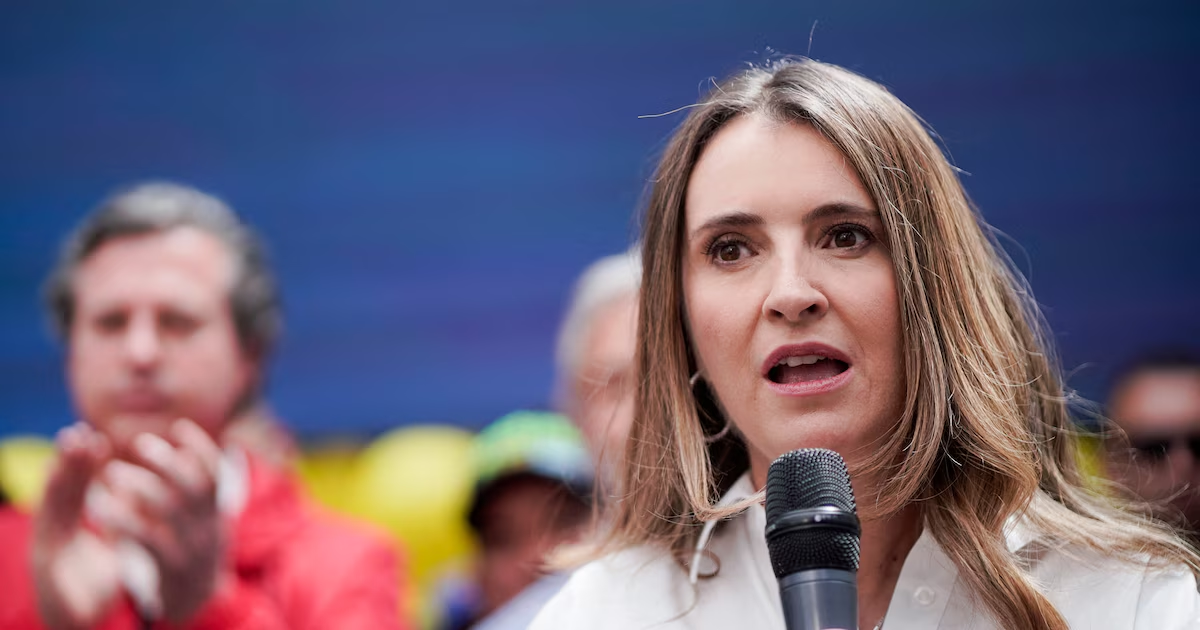
Senator and presidential candidate Paloma Valencia accused President Gustavo Petro of implementing an electoral strategy by requesting the Attorney General’s Office to suspend the arrest warrants against members of the Gulf Clan, a decision that, according to Valencia, puts the transparency of the elections at risk and favors illegal armed groups within the framework of the “total peace” policy.
From her social networks, the congresswoman published several messages in which she insisted that The suspension of 29 arrest warrants for the self-proclaimed Gaitanista Army of Colombia responds to “an electoral strategy”, accusing the national government of releasing criminals and transferring them to locations.
“Look, what is happening with this government and the Total Peace of Iván Cepeda is very serious, where they cleared the ground for the violent and they are pressuring with rifles to vote for him”assured the senator from the Democratic Center.
In another message, Valencia described the measure as a “coup d’état to the elections,” linking the Clan del Golfo as “founding partner of the La Picota Pact that elected @petrogustavo with its votes according to his brother’s confession.”
The senator added: “Drug trafficking pure and simple, natural ally of @IvanCepedaCast, at ease from its clearing zone”.
President Gustavo Petro made a formal request to the Attorney General’s Office to suspend the arrest warrants for 29 members of the Gulf Clan. including its main leader, Jobanis de Jesús Ávila Villadiego, alias Chiquito Malo, wanted by the United States for drug trafficking and terrorism crimes.
This measure aims to allow the transfer of these members to the Temporary Location Zones (ZUT) on June 25, 2026, in order to facilitate peace dialogues with the armed organizationconsidered the most far-reaching in Colombia and responsible for a significant part of drug trafficking and illegal mining and extortion activities.
The resolution, signed by Peace Commissioner Otty Patiño, establishes that the suspension of captures will be valid only during the transfer process and under specific conditionssuch as time, place and purpose restrictions, all strictly linked to the negotiating process.
The measure requires the express endorsement of Attorney General Luz Adriana Camargo, who is evaluating the legality of the request.
The dialogue process with the Gulf clan, begun in August 2025 and carried out outside Colombian territory, has had the participation and international supervision of countries such as Qatar, Spain, Switzerland and Norway.
The areas designated for the relocation of combatants are located in Tierralta (Córdoba), Unguía and Belén de Bajirá (Chocó). Entry was originally scheduled for March 2026, but was postponed due to logistical problems, adverse weather conditions and the death of a senior member of the group.
The temporary suspension of arrest warrants is protected by Law 418, which regulates peace processes with organized armed groups.. It will only be applied during activities directly related to the transfer and preparation for entry to the ZUT.
The decision also contemplates that, if the established deadlines or conditions are not met, the suspension could be revoked, as already happened in March 2026 when the Government annulled it due to inaction in the transfer.
Among the 29 members mentioned in the resolution are names such as Tatiana Andrea Correa Jaramillo, José Francisco Peña Santana and Luis Enrique Martínez Cogollo, in addition to the aforementioned ‘Chiquito Malo’. The acceptance of the list is carried out under the principle of good faith and with the obligation to notify the corresponding authorities to activate the legal suspension mechanisms.