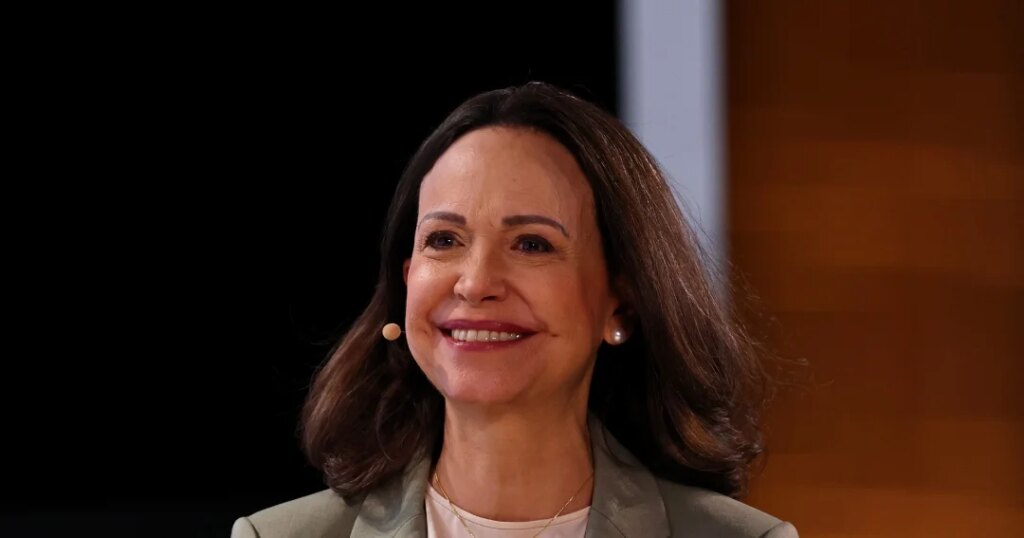
Venezuelan opposition leader María Corina Machado hopes to return to her country before the end of 2026 and is urging the United States to accelerate plans for holding elections.
In an interview with Reuters on Sunday night, the Nobel Peace Prize winner said she “absolutely” saw herself returning to Venezuela soon, and warned that The longer the country took to hold elections, the greater the risk of civil unrest.
“We believe that to (manage) the anxiety, expectations and urgency of the Venezuelan people in an orderly and civic manner, it is very important to begin taking steps towards what the entire country requires and demands, which are free and fair elections,” he said.
The United States captured President Nicolás Maduro in January, raising hopes among some of his opponents that Machado, 58, would play a central role in running the country. In her place, the president of the United States, Donald Trump, put Delcy Rodríguez, Maduro’s former vice president, in charge. alleging that Machado did not have the necessary support to lead the country in the short term.
Machado left Venezuela in December, defying a decade-long travel ban, to receive the Nobel Prize in Norway. after having lived mainly underground for more than a year following the controversial 2024 elections.
Maduro was declared the winner in those elections against opposition candidate Edmundo González, sparking protests throughout the country. Machado, an industrial engineer by training, had been prohibited from running for office.
Rodriguez has since earned praise from the U.S. government for her performance, but Machado rejected it as a sign that Trump wanted her in office for the long term. “What I heard was President Trump praising how she follows his instructions,” she said.
“They (the Government of Delcy Rodríguez) have never been as weak as now, (…) they are beginning to realize that things have changed and that this is a totally different moment.”
Machado said that, with the capture of Maduro, Venezuelans expected important changes in the Government and the economy, and that those Expectations had to be met quickly to avoid the risk of “anarchy.”
“It’s like a huge dam that has been (accumulating) more and more energy, frustration, courage and expectations,” he said.
“My challenge, our challenge, is to channel those energies in a peaceful, civic way, with a single objective, which is an electoral process. “If people feel like that’s not the purpose of everything that’s happening, these forces could get out of control.”
Machado said that it is necessary to update the electoral roll before the elections to include those who were previously prohibited from voting, and that new members of the electoral council must be selected, something that could be achieved “in eight or nine months.” He stopped short of saying that Trump, to whom he gave his Nobel Prize medal, was not acting quickly enough.
“We would not be where we are now, moving forward, if it were not for the decision of the US Government and President Trump to bring Nicolás Maduro to justice. But, without a doubt, I understand the urgency and demands of my people and I believe that we must advance in the democratic and electoral process,” he said.
Criticism with Spain
During her trip to Madrid, Machado held a rally for exiled Venezuelans on Saturday, drawing thousands of people to the Spanish capital’s Puerta del Sol to hear her say they would soon be able to return home.
About a quarter of Venezuela’s population has spread across Latin America, the Caribbean, Spain and the United States since 2014, fleeing an economy dependent on oil and paralyzed by mismanagement.
He met with leaders of Spain’s right-wing opposition but refused to meet Prime Minister Pedro Sánchez, telling Reuters that La Moncloa had not done enough to stand up to the Maduro regime.
“We hoped that Spain would perhaps be the main voice in highlighting the horrible situation in our country, the crimes against humanity that have been committed, the state terrorism that has been deployed. Unfortunately, that wasn’t the case.“.
“Fortunately there are other voices, and I have met with some of them this week, and we certainly feel that in Europe We have an ally of Western values and to rebuild institutions in Venezuela that will last for centuries.“.
Since he left Venezuela, Machado has resided primarily in the United States and has expressed his joy at being reunited with his three adult children.. “As a mother, I have always felt very guilty about the consequences that my family, especially my children, have suffered because of my decisions,” she said.
“I tell myself every day that I do it for them, for each and every one of the young Venezuelans and for those who have not yet been born, so that they have a country that they are proud of and can live as free citizens.” Machado asked her children to live abroad for safety reasons after becoming a representative.
He has also enjoyed catching up on the technological advances of the last 20 years that had not reached Venezuela, and says that discovering the Uber transportation service was a revelation. “On the other hand, I am used to my country. I feel like I should be back with my people and I’m counting the days“.