A ruling handed down by a civil court resolved condemn an electrical energy concessionaire company to pay millionaire compensation to a minor who suffered serious injuries from an electric shock when touching a light pole on a public road. The ruling is based on the objective responsibility of the electric service provider for the lack of supervision and maintenance of its facilities.
The claim was initiated by the minor’s mother, who acted on behalf of her son. According to the lawsuit, on March 8, 2014, around midnight, the child accidentally came into contact with a light pole located next to a bus stop in Nueva Pompeya. The contact caused an electric shock of such intensity that it threw him to the floor, causing burns to his left hand and arm, as well as other injuries.
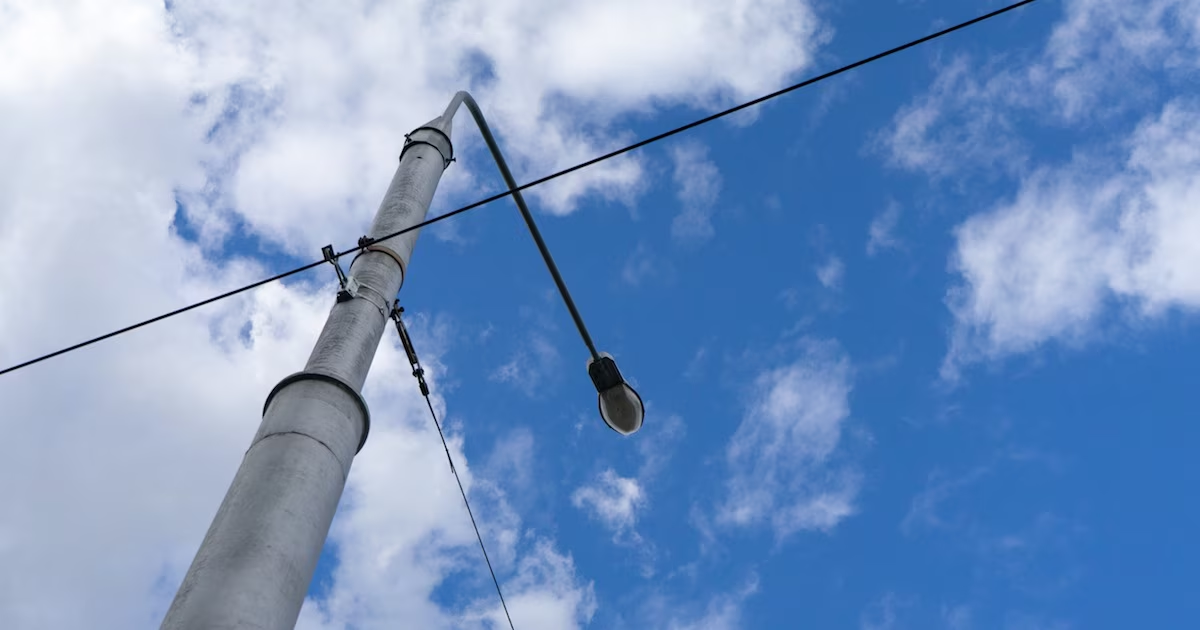
According to the court filing, the light pole lacked a protective cap and had exposed wires, without any warning about the danger. The minor’s mother reported that after the accident she requested medical help, which led to the child being transferred to a public hospital, where he was treated for injuries and shock. The next day, the woman filed a complaint at the corresponding police station.
The court explained that the claim included compensation for physical damage, moral damage, psychological damage and psychological treatment expenses. The company’s defense denied the occurrence of the accident and maintained that responsibility for the maintenance of the poles corresponded to the Buenos Aires municipality. In addition, he argued the mother’s fault for lack of supervision over the minor.
The case went through an extensive evidentiary stage, in which testimonies, medical reports and expert opinions were incorporated. Among the evidence assessed were the statements of a neighbor who witnessed the incident and a security agent who intervened at the scene, who agreed that the pole was in poor condition and that the minor received an electric shock.
The security agent reported that, after being alerted, he noted the absence of the protective cover and the presence of loose cables. He requested medical assistance and the intervention of personnel from the energy company, who came to carry out emergency repairs on the affected pole. The photographs incorporated into the file provided visual support for these testimonies.
The magistrate, in charge of the National Civil Court No. 46, considered the accident proven and rejected the company’s defense regarding the alleged fault of the mother or the exclusive responsibility of the municipality. He based the decision on the legal framework in force at the time of the events, which establishes the objective responsibility of those who operate risky activities, such as the distribution of electrical energy.
The ruling stressed that The company had to exercise strict surveillance over its facilities due to the dangerous nature of the service it provides.. He highlighted that the lack of a cover and the exposure of cables made the pole a risky thing, which made the presumption of liability applicable.
For the court, the company could only have been exempted from liability if it proved that the damage resulted from the fault of the victim or a third party, which was not proven in the file.
Regarding compensation, The judge evaluated both the physical and psychological consequences suffered by the minor. The medical report recorded burns on the forearm and index finger, with a percentage of permanent disability. The psychological expertise assigned a 15% psychological disability due to the post-traumatic condition suffered.
The court set compensation of eight million pesos for psychophysical incapacity and an additional amount of one million four hundred forty thousand pesos to cover the recommended psychological treatment. Furthermore, it established the sum of five million pesos for moral damage, considering the suffering and anguish suffered by the child as a result of the accident.
Regarding interest, the ruling determined that an annual rate of 8% will be applied from the default until the date of the ruling, and from then on, the active rate of the Banco de la Nación Argentina for loans, in line with the current plenary doctrine.
The resolution also addressed the issue of professional fees, which total several million pesos and must be paid in accordance with the amounts and percentages established by law.
The judge emphasized that the sentence and fees must be served within ten days, under warning of execution. In addition, it ordered notification to the intervening minor defender and ordered the filing of the proceedings once the required procedures had been completed.
The ruling represents a relevant precedent in terms of liability for accidents caused by the poor state of urban infrastructure, and highlights the duty of borrowing companies to act with maximum diligence in supervision of the elements they use to provide essential services.
The magistrate cited several rulings from the Supreme Court and civil courts to justify objective liability and the obligation to compensate for damages caused to third parties due to the lack of adequate maintenance of electrical installations.
The ruling establishes that the compensation must be delivered in favor of the minor, represented by his mother, and that the defendant company will face all of the legal expenses derived from the process.
The file included expert reports that confirmed the physical and mental injuries suffered by the child, as well as the estimated cost of the therapeutic treatment required for the consequences of the accident.
The total amount of the sentence reaches fourteen million four hundred forty thousand pesosa sum that includes the different compensation items recognized by the intervening judge.
The court ordered that, once the payments have been made, the file will be archived and the resolution will be communicated to the relevant areas of the judicial system.
The case highlights the importance of supervision and maintenance of public services in urban areas, and the protection of the rights of minors against risk situations due to lack of security in public spaces.