The Casa Rosada is considering the possibility of putting aside the Primary, Open, Simultaneous and Mandatory elections (PASO). In provinces where there are similar governments, this alternative is gaining momentum. In Chaco and Between Riversfor example, are already working in that direction.
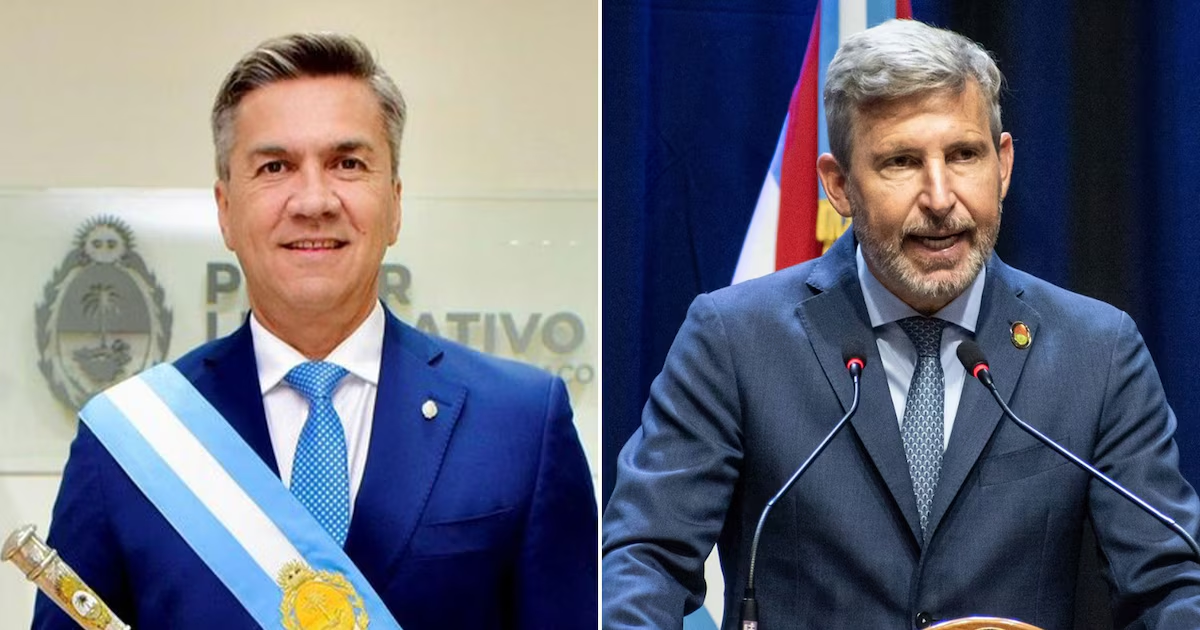
The Chaco Podemos block, made up of the governor’s space Leandro Zdero and the libertarians, presented an initiative in the provincial Legislature to suspend the PASO. The criterion they use is that it will allow significant savings of money in lean times.
“A primary involves an expense of $4 billion”he said to Infobae the libertarian Iván Gyoker, president of the caucus.
Something similar is suspected in Entre Ríos, although the project has not yet taken shape. A senior administration source headed by Rogelio Frigerio He confided to this medium that the possibility is one of the alternatives under study. At the front, headed by the governor who will seek re-election next year, not going to primaries is in his best interest. But not to Justicialism, which needs to be reorganized after the latest electoral debacles.
The Chaco ruling party presented the initiative on Monday to put aside the open internal process. Specifically, it proposes suspending it for a year.
“The organization of an additional electoral process involves a large-scale logistical, operational and economic deployment,” the project indicates.
And he adds: “The suspension of the primary elections is presented as a measure aimed at optimizing the use of public resources.” This will allow the reallocation of funds “to priority areas of management and contributing to the organization of provincial accounts,” he adds.
In Entre Ríos, meanwhile, the possibility of canceling the primaries would go hand in hand with bringing forward the elections. But it would imply splitting them from the national ones. This is not something that the central government at all likes. The alternative is that they are concomitant even if voting is done in separate ballot boxes and cubicles, since Entre Ríos has its own unique ballot.
What are the reasons
The Chaco ruling party put on the table the factor of absenteeism and the overload of elections as phenomena to keep in mind when suspending the PASO. “It should be considered that electoral participation has shown a lower turnout over time. In this sense, this measure also tends to simplify the electoral calendar, avoiding the repetition of calls to the polls and facilitating citizen participation”, argues the legislative initiative.
If Frigerio intends to leave aside the primaries, he will first have to convince his own people of the tactical convenience of the measure. The fact is that its provincial front has the UCR as its backbone, and the internal one is the favorite sport of the “white berets.” So much so that the historic leader Juan Carlos Pugliese, president of the Chamber of Deputies during the administration of Raúl Alfonsín, used to say that for the radicals the government is an annoying fact between two internal ones.
No one at the UCR Entre Ríos is in a position to challenge Frigerio for leadership. It would not be a business for LLA to confront him and divide the vote either. In 2023, the former Minister of the Interior defeated the Peronist Adán Bahl by a slim margin. A large part of its potential electorate leaned towards the libertarian option that Sebastián Etchevehere embodied.
Frigerio, Karina Milei and cousins Martín and Eduardo “Lule” Menem discussed something about this last Tuesday at Casa Rosada. In the recent past there is legislative 2025. On that occasion they went together and crushed the PJ.
The ambition of Yrigoyen’s Entre Ríos heirs focuses on legislative positions and local governments.
The Peronism of Entre Ríos, for its part, considers it likely that Frigerio will advance with these two schemes. That is why he is on guard to face the post-World Cup period as if it were definitive. In their sights is an internal one in November that will allow them to reach 2027 with defined names for the provincial dispute, at least.
In Chaco, the initiative to cross out the first ones during 2026 highlights that it is an “exceptional and temporary” action. “It does not affect the normal development of the general electoral process or the functioning of the democratic system,” he points out. On the contrary, he argues, it guarantees that the selection of candidates “continues to be carried out within the scope of the political forces in accordance with their respective internal regulations.”