Financial Diary – Santiago
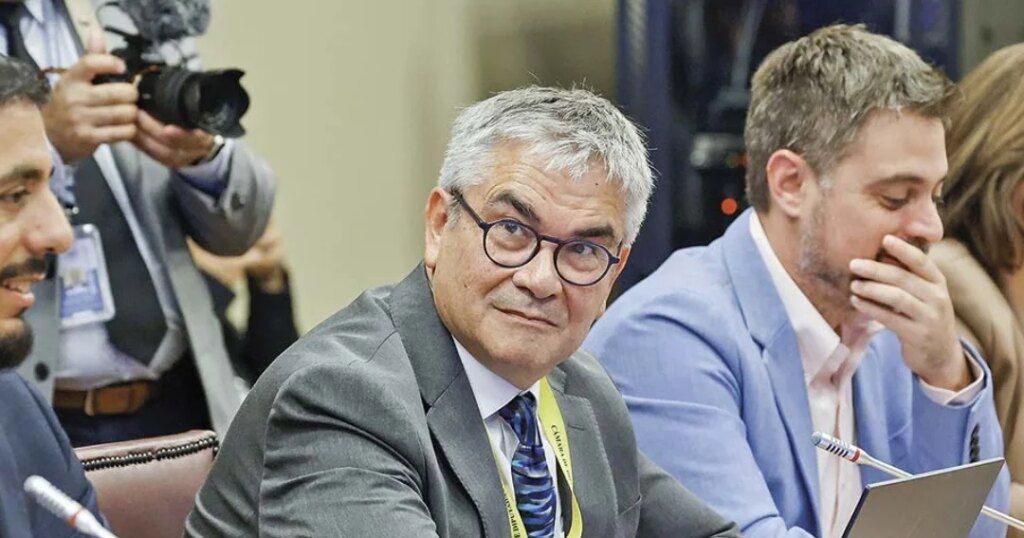
Exactly 33 weeks had passed since the last time the former Minister of Finance, Mario Marcel, had set foot in the Chamber of Deputies, in Valparaíso.
He himself recognized it, in a playful tone, at the beginning of this Tuesday’s session of the Corporation’s Finance Commission, as far as he went when invited by the body to address the fiscal situation inherited by the government of José Antonio Kast. Marcel was Gabriel Boric’s Minister of Finance between March 2022 and August 2025.
His presentation, which generated high expectations in the Lower House, was preceded by the harsh presentation of the Minister of Finance, Jorge Quiroz, who just a week before had highlighted the ailing budgetary situation that the new Executive inherited, with barely US$46 million in the fiscal coffers; a deviation from the fiscal goal equivalent to 3.9% of GDP between 2023 and 2025; and a reduction in the level of sovereign funds by around US$4 billion in the last four years.
In a markedly considered style and without the intention, he said, of directly arguing with Quiroz, The former president of the Central Bank also sought to refute each of the statements of the current Secretary of State, starting with the fiscal deficit.
Thus, he pointed out that Quiroz did not incorporate the year 2022 in his analysis, when the Treasury recorded a structural surplus of 0.2% of GDP, which contrasted with the deficit of 3.3% of Product projected for that year.
Thus, he said that if that year was incorporated into the analysis, the deviation of 3.9% of GDP becomes a balance in favor of 0.1% of GDP since exceeding the goal in 2022 “compensates for non-compliance in 2024 and 2025.”
The discussion about the tax fund
Likewise, he addressed the intense debate about the cash level that Quiroz denounced, explaining that the balance has no implications on the operation of the fiscal apparatus, but rather on the level of debt and debt repayments. Thus, he said that it is not working capital, contrary to what Quiroz had indicated.
“In December 2025 (when it was reported that there were only US$46 million in cash) nothing happened in the State. Nothing was paralyzed and public officials were not stopped being paid. It didn’t cause any specific damage. And what happened when the cash balance was US$14 billion? We don’t spend like crazy either. The box is not something central. The cash does not matter to anyone, except for countries that do not have access to the credit market. “They will never see a report from the IMF or the World Bank on the fund,” said the former minister, pointing out that Chile maintains “privileged” access to international markets.
In fact, Marcel took charge of what was reported by Quiroz that the Treasury had borrowed US$6,525 million in February to increase the amount of the cash.
He explained that US$5,036 million of that issue were allocated to debt amortization and US$1,489 million to increase the Other assets of the Public Treasury. and recalled that four years ago, before the change of Government from Sebastián Piñera to Gabriel Boric, the then outgoing administration issued US$6,000 million that was almost entirely allocated to increasing the Economic and Social Stabilization Fund (FEES), which generated a loss due to rate differential of US$300 million to the Treasury.
“Of course, those of us who had responsibility in this period would have wanted to show more significant progress at the end of this cycle. “We were the first to regret the failure to meet the structural goal in 2024 and 2025, but that is not equivalent to a fiscal crisis, it is not equivalent to a bankrupt State,” he concluded.
Grau’s minutes
Who was also invited to the event was Marcel’s successor until March 11, Nicolás Grau, who excused himself from attending for work reasons.
Instead, he sent a seven-page minute, in which he stressed that although the country has challenges in fiscal matters, Chile has an “orderly” macroeconomy and full access – in good economic conditions – to the international market, which allows us to face this challenging global scenario with a set of broader alternatives than other countries.”
In the text, he highlighted that debt as a fraction of GDP was reduced “marginally” in 2025 for the first time in almost two decades, while the weight of public spending on the Product is also lower compared to 2022.
“Chile is evaluated very favorably by risk agencies, which allows it to access loans with good terms and interest rates,” he added.