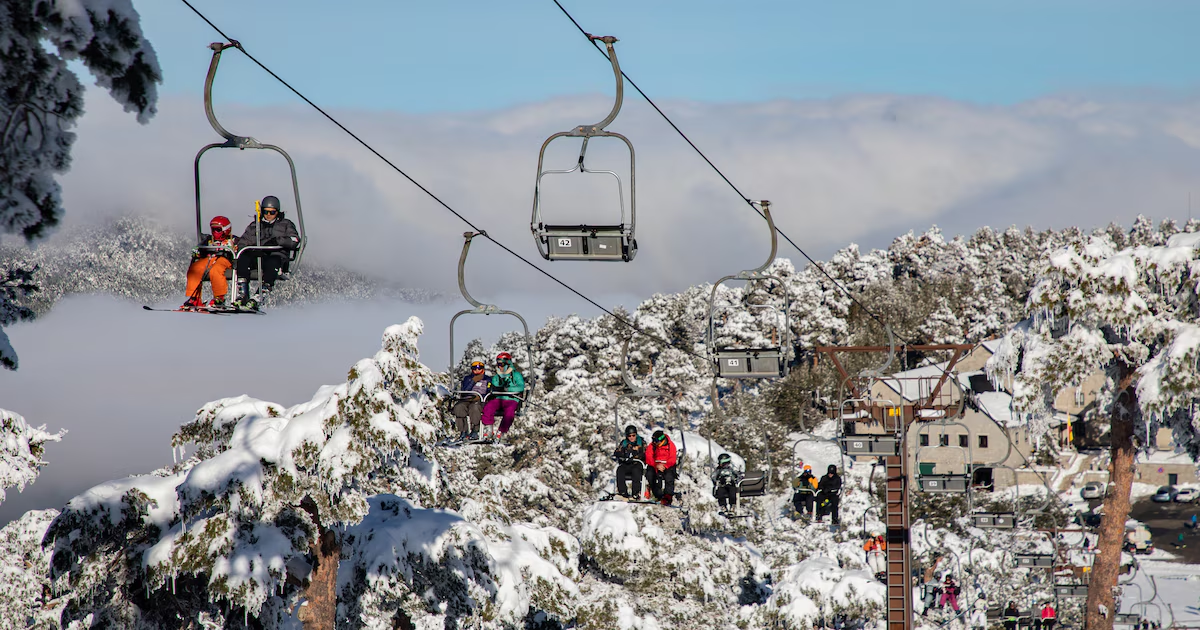
After five years of litigation, the Supreme Court has finally endorsed the dismantling of the ski resort of the Port of Navacerrada on the Castilian-Leonese side. This Wednesday, the 2026 season ends.
The Contentious-Administrative Chamber of the High Court has rejected the two appeals filed by the Junta de Castilla y León and the concessionaire company against the ruling of the Superior Court of Justice of Castilla y León. The TSJCyL established on January 31, 2024 that the dismantling of the infrastructure had to be activated and that the regional Executive had the obligation to process the expiration file of the authorization to occupy the public mountain where the ski slopes run.
Thus, the Supreme Court in its ruling – dated March 18 and released this Tuesday – certifies what has already been established by the TSJCyL: that the installation must be dismantled and that the Mount Pinar de Valsaín to its previous state. The autonomous community is responsible for forcing Puerto de Navacerrada-Estación de Esquí, SA, the concessionaire company, to comply with these obligations. In addition, the Junta de Castilla y León must pay the costs of the Supreme Court to the State Attorney’s Office.
Since March 2021, the Segovian slopes of Escaparate, Telégrafo and El Bosque did not have the administrative concession that authorizes their operation. That year, taking into account the consequences of global warming, high human pressure and the fact that its surface includes land with protection figures, the Autonomous Organization for National Parks (OAPN) – dependent on the Ministry for the Ecological Transition and the Demographic Challenge (MITECO), decided not make a new concession after expiration of the 25-year validity period of the previous one.
“The decision will revert these mountains to the public forest domain, guaranteeing the environmental and landscape restoration of these high-value lands, located in the surroundings of the Sierra Norte de Guadarrama National Park and cataloged as a Special Management Zone, which would become part of the Cumbres Limited Use Zone,” stated the OAPN in the 2021 press release, which indicated that the clearing must be completed before October 30 of that same year.
This was not so. Following the interest of the Junta de Castilla y León in continuing with the ski activity in Navacerrada, litigation began that has finally ended with the rejection of the procedure by the Supreme Court of the appeals of two cassations.
The Government, at the time it decided not to renew the concession, alleged various reasons. Firstly, that the surface of 7.6 hectares “has various protection figures. The slopes and chairlifts border the Sierra de Guadarrama National Park; The water intake of the Telégrafo stream is located upstream from the beginning of the section of the Eresma River, declared the Alto Eresma Fluvial Natural Reserve, and the land is located within the Real Sitio de San Ildefonso – El Espinar Biosphere Reserve, the Special Protection Area for Birds (SPA) and the Sierra de Guadarrama Special Conservation Area (SAC), which is part of the Natura 2000 Network.
Secondly, MITECO referred to climate change: “Since the 1970s (decade of best conditions for the existence of snow in Navacerrada), the average temperature has increased by 1.95 ºC, the average minimum temperature has also increased by 0.77 ºC and snow has reduced by 25% (frost days decrease by 21.6 and snow days by 24.2).”
Along with this, the OAPN pointed out “the high tourist pressure and recreational that the area suffers”, since the Port of Navacerrada “supports a serious problem of saturation and access, crowds that, at times, represent a problem of public order and citizen safety, waste contributions without a clear solution for its collection and evacuation.”
In 2024, Ecologists in Action Sierras of the Community of Madrid, which denounced the opening of the Puerto de Navacerrada Ski Resort despite the ruling of the TSJCyL, referred to the “serious environmental impacts” that this activity generates “in the fragile natural environment of the mountain peaks.”
The environmental organization referred, for example, to the “economic and energy waste of the artificial snow production“, the “large human agglomerations associated with waste”, the “alteration of water in its sources” or “the infeasibility of keeping the station open due to global warming of the planet.”
The Supreme Court’s decision regarding the TSJCyL ruling only refers to the ski slopes on the Segovian slope, not those of the Community of Madrid. In fact, in December 2024, the Government of Isabel Díaz Ayuso announced a new concession for the Madrid side for a period of 29 years. Only the company Puerto de Navacerrada Estación de Esquí SA, the same company that operated previously and the one in charge of the Segovian side, participated in the awarding contest.
Thus, for the moment, the Navacerrada ski resorts in the part belonging to the Community of Madrid will not be affected. However, the dismantling of the Castilla y León facilities set a precedent in regards to decisions to close or environmentally restore this type of enclaves located in protected areas and where snow is becoming increasingly scarce.