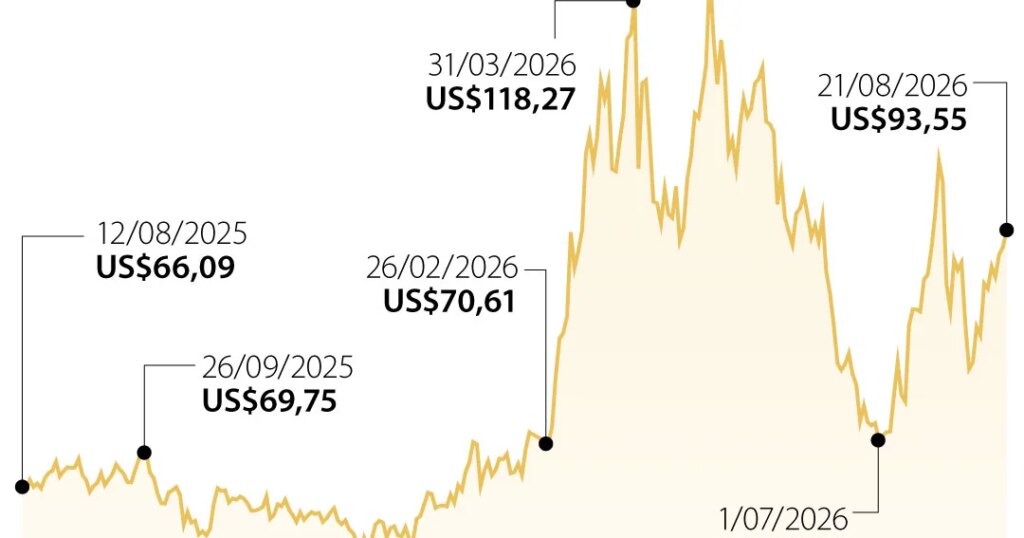
While President Javier Milei meets with investors in New York in a bid to attract interest in Argentina’s recovery story, The momentum behind the country’s bonds has largely stalled.
Despite all the achievements (his administration is keeping inflation under control, rebuilding central bank reserves and relaxing exchange controls; he just approved a long-awaited labor reform), Argentine bond spreads over benchmark US Treasury yields are still about double what Milei wants. They fell to a multi-year low in January but have since recovered, with the rally fading even before the conflict with Iran erupted and rattled global markets.
At the inaugural Argentine Week event at JPMorgan’s new headquarters in New York, Milei attributed the impossibility of a further fall in long-term sovereign bond spreads to next year’s presidential elections. The political risk associated with the elections “continues to hurt” bonds maturing after the end of his first term in 2027, Milei said.
“That catastrophic scenario, that black swan, continues to hurt positions beyond 2027,” Milei said. “But we are doing everything we can to put an end to populism once and for all. We performed well in the midterm elections. Let’s hope we do even better in the general election.”
Milei’s rise to power and his decisive victory in last year’s midterm elections sparked a massive revaluation of country risk. However, more recent achievements have led to smaller movements. A problem for Argentina, according to some investors, is that sovereign bonds are still rated well below the junk bond level, which practically marginalizes a large group of potential buyers. such as pension funds, insurance companies and emerging market funds that have strict limits on low-rated debt.
“The spread situation in Argentina is no longer about a lack of good news, but about saturation of demand,” said Mauro Favini, senior portfolio manager at Vanguard. “The country is already one of the emerging markets with the highest demand for high-conviction bonds, but right now, the spreads are based less on the holders and more on who can buy the bonds.”
The The country’s sovereign debt has been upgraded several times since Milei took office in 2023, but it is still seven notches below investment grade in the three major credit rating agencies. Both S&P Global Ratings and Moody’s Ratings maintain a stable outlook on the debt (Fitch does not assign a CCC+ or lower).
S&P, which last raised Argentina’s rating in December, said then that The outlook balanced the risks posed by persistent economic vulnerabilities with improving fiscal outcomes and strengthening investor confidence. Measures to access external capital markets, he added, should give the government greater flexibility to manage its debt.
Investors have been attentive to signs of when Argentina will return to the markets. Milei’s team was contemplating a bond issue (the first since the previous administration defaulted on its debt in 2020) in January, but put the brakes on the process. Now, the war in Iran has virtually shut down the high-yield debt market, making new issuance in the near term more unlikely.
“Small steps have been taken towards greater flexibility and, potentially, greater solvency,” said Joydeep Mukherji, managing director of sovereign ratings at S&P. “There is a virtuous circle that could begin, but we haven’t seen it yet, at least not enough to make changes.”
Government officials have expressed frustration that, despite significant improvements and legislative approvals, yields continue to decline. The Minister of Economy, Luis Caputo, believes that the spreads should be close to 250 to 300 basis points. Spreads are around 600 basis points, while short-term dollar bonds maturing within Milei’s term are trading at significantly lower yields.
“If someone had told me that we would buy the amount of reserves that we did, I would never have predicted that country risk would increase,” Caputo said at a conference this month. He argued that current levels “do not fully reflect achievements.”
Full house
Before Milei took the stage Tuesday, JPMorgan Chase CEO Jamie Dimon He described the Argentine leader’s economic turnaround as “fantastic” and praised his success in reducing inflation as a “miracle.”
Milei’s remarks attracted an audience packed with local executives, regional and international bankers, and global fixed income investors. Senior members of his cabinet, including the governor of the central bank, the minister of foreign affairs and the minister of deregulation, attended an event focused on investment opportunities in the real economy.
The CEOs of Argentina’s largest energy companies were among the most sought-after attendees. Among them were the directors of YPF, Pampa Energía, Pan American Energy and Vista, all recent issuers in the debt capital markets, which helped Argentina reestablish its corporate financing portfolio.
“Now it is our responsibility to take advantage of this opportunity and attract investment,” stated Marcelo Mindlin, executive director of Pampa Energía.
Milei also harshly criticized two Argentine executives who were not present, blaming them for promoting the protectionist economy he is trying to promote. He specifically denounced the billionaire Paolo Rocca, the business giant that drew Milei’s ire after his company, Tenaris SA, offered a 40% higher quote for a government contract than an Indian competitor, who was eventually hired for a major pipeline contract.
‘Marginal’
The central bank’s weak reserve position, despite having outlined a plan to rebuild it, remains the most pressing problem for investors. There is also concern about the slowdown in growth and the country’s monetary policy.
The Milei’s administration has shown little appetite for issuing international bonds at current prices, even though investors widely agree that the country is already in a position to borrow. with yields below the 10% threshold often considered a viable level for issuance.
“There is a lot of Argentine debt in the market, and those who already own it are waiting,” said Diego Ferro, director of Faro Fund in New York. “Right now, purchases are marginal.”